A Bride By the Book

You are married now.

You have just taken the name of the most wonderful man in the world and are happier than you have ever thought possible.

You are sure of many things about your marriage. It isn’t going to turn sour and commonplace. The years will be vibrant and alive, exciting adventures of love. Christ is going to have first place in your home. The spiritual roots will be deep and strong. you are going to keep your home what it ought to be by being a sweet, agreeable, efficient wife and homemaker.

So begins The Bride’s Book of Ideas: A Guide to Christian Homemaking by Marjorie Palmer and Ethel Bowman.

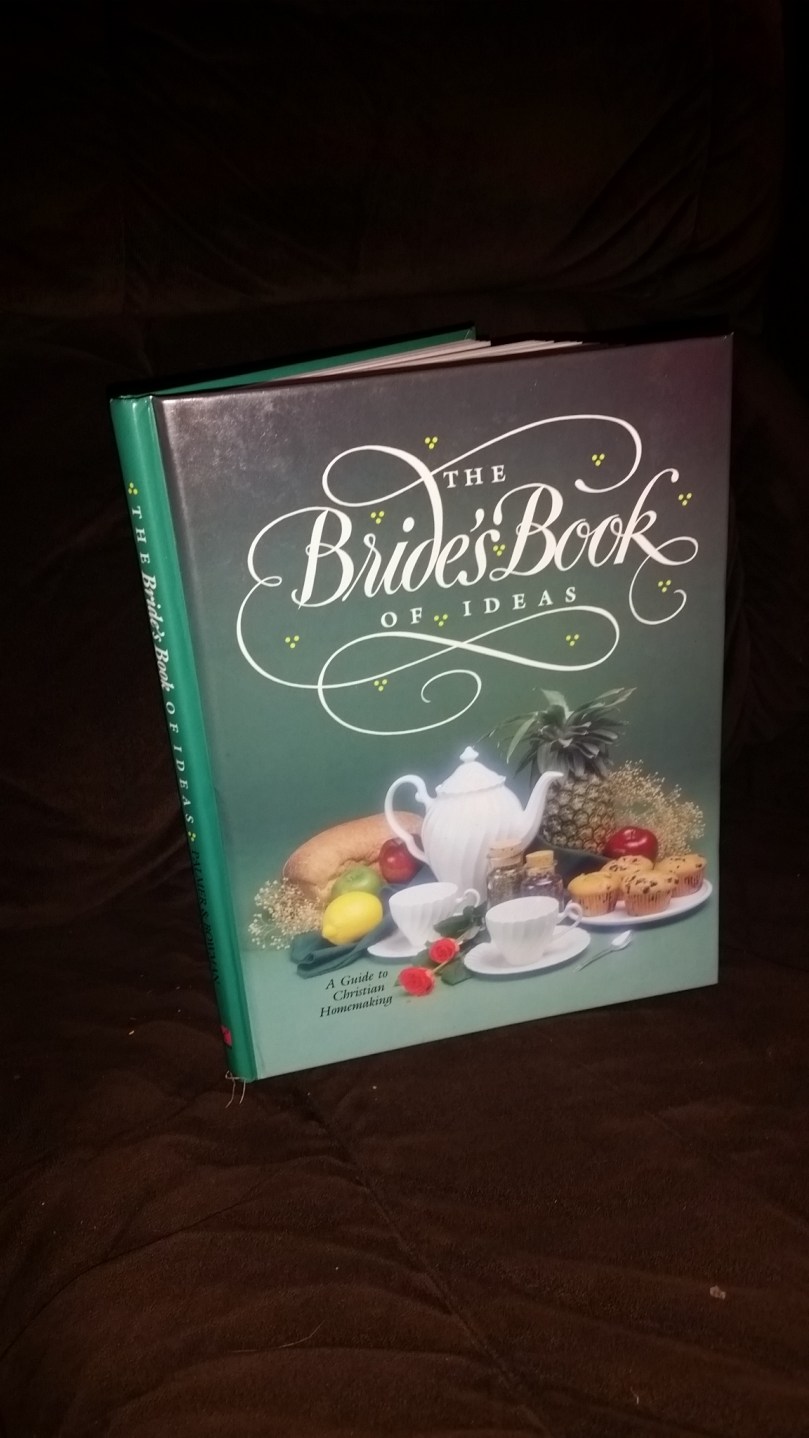
The whole reason I have the book is because of a Facebook photo that makes the rounds occasionally. It purports to be advice to a 1950s housewife, and is incredibly blatant about the fact that the wife’s entire purpose is to make her husband’s life comfortable and stress-free. That was the job of a good wife, definitely; but I wonder if it was ever really stated so baldly. Someone said that the advice was from a Better Homes and Gardens bride’s book, so I went looking for it. Couldn’t find that book, but I did find The Bride’s Book of Ideas and ordered that one instead.
20170814_221126

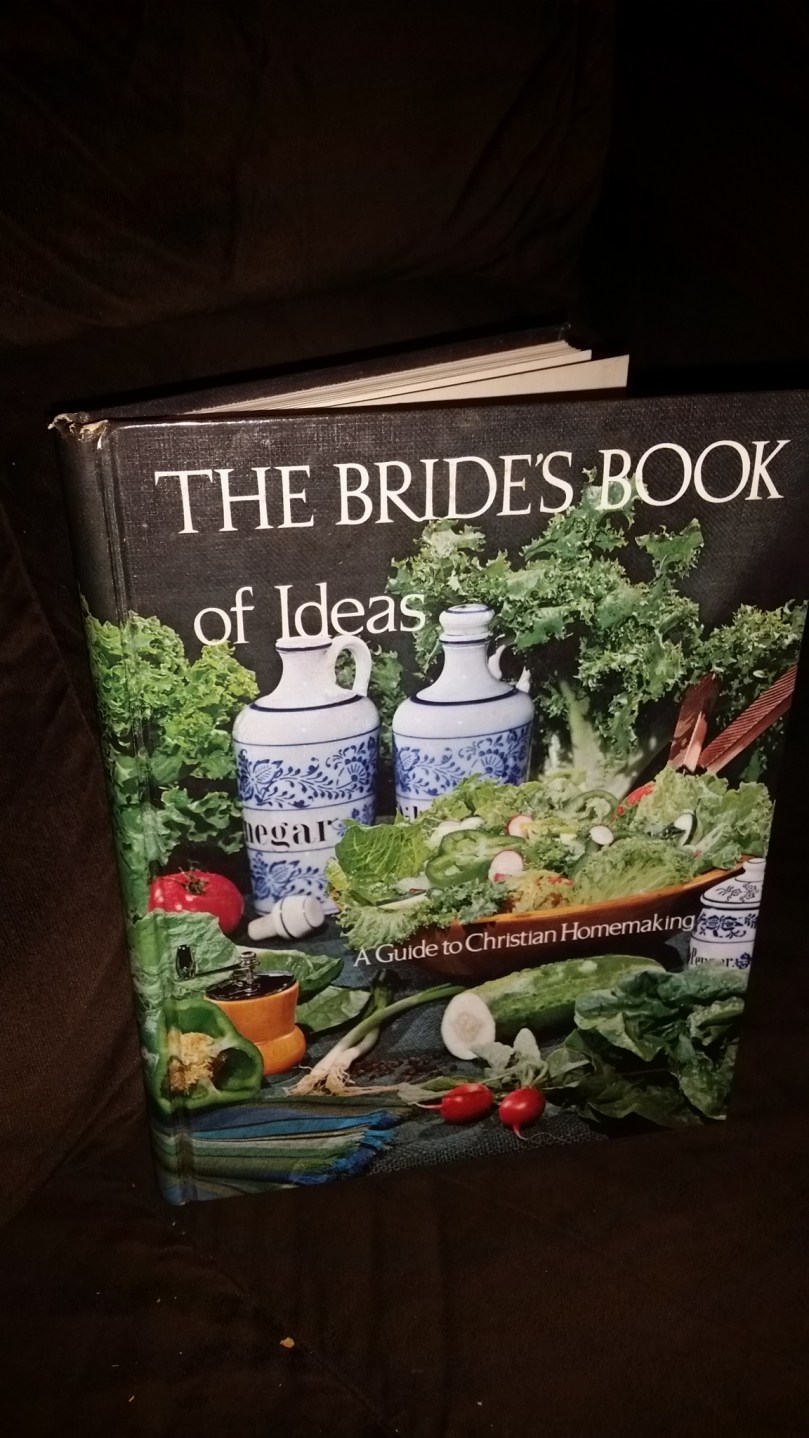
Then I found out that I’d gotten the 1985 version. I developed a burning need to read the 1970 version — so I got that one, too.
20170814_221153

I was looking forward to comparing the two volumes and soundly mocking all of the advice therein. The updated version has a much-improved layout and design, with a few wording changes here and there; but the substance is the same as the earlier one. The first part contains advice to new brides on such practical matters as choosing insurance, finding a family doctor, first aid, kitchen essentials, how to set a table to entertain guests. The rest of it consists of easy recipes to get a new wife started in the kitchen.

So it’s with some disappointment that I report that, by and large, The Bride’s Book of Ideas is fairly tame and actually kind of useful.

But it is of its time, and I can poke a little fun at that.

(Note: I’ll refer to both volumes as one book unless I’m quoting from a specific edition.)

Marriage Advice
Naturally, the book has some space devoted to motherly wisdom, The Precepts of a Happy Home. Most of the points under this heading are unobjectionable:

Be content with what you have (1970 warns against buying too much on “the installment plan.” 1985 cautions against credit card debt.)

Treat your husband with courtesy and respect and expect the same from him. Despite this even-handed heading, the actual advice is aimed only at the wife, reminding her not to take advantage of her husband’s love by giving way to anger and frustration, and to practice the Golden Rule. Obviously it’s a bride’s book, so it’s talking to her; and I don’t disagree with the advice at all. But this is an example of the kind of wifely advice that persists even today in Christian circles, directed only at the wife with no discussion of her husband’s behavior toward her.

Don’t let disagreements and differences go unresolved. This is probably the area where my husband and I have had to do the most work. We don’t fight, therefore we don’t face conflict, therefore we don’t resolve problems.

(The book concerns itself quite a lot with keeping home like “sweet and harmonious,” which sounds great. But sometimes “harmonious” really means “not facing conflict.” Trust me on this.)

The two points that irked me were ones that I heard as a bride myself, but haven’t found to hold entirely true.

Give the Lord his rightful place in your marriage. “If you want God’s help in making your marriage successful, you must give your lives completely to him.” The authors warn against a new couple being so caught up with each other that they let church attendance become sporadic, and daily Bible reading and prayer turn meaningless and indifferent.

No argument that this can happen to a new couple — but because they’re too in love with each other to let God in? Seriously? What a way to instill insecurity in a new wife, by telling her not to love her husband too much or God won’t bless her marriage.

And, of course — Remember that your husband is the head of the home. The two editions have an interesting little wording change:

1970: Some brides resent a subordinate role and are determined not to allow this antiquated precept to have any place in their lives.

1985: Some brides resent what they view as a subordinate role and are determined not to allow this “antiquated” precept to have any place in their lives.

Note the 1985 version implies that it’s really just the woman’s perception of subordinate role. By the time I was hearing marriage advice as a teen in the 90s, teachers fell all over themselves to explain how it’s not really a subordinate role at all! It’s a blessing! It’s an honor! I kind of prefer the straightforward 1970s version.

Both versions put these upstart brides in their place by adding, “But God charges the husband with the responsibility for making major decisions and being the spiritual leader of the home.” I can see some basis for the “spiritual leader” argument, but where exactly does God state, “And husbands are to make all the major decisions, because I won’t bless a marriage where the wife has an equal say.” Hint: he doesn’t.

So, anyway, if you “practice these precepts,” your marriage “will be happy and will bring honor and glory to God.”

Housecleaning
They cheerfully advise the new wife to do some special cleaning in addition to her regular cleaning — and remind her not to neglect the out-of-the-way areas because she’s building good habits for the rest of her life.

“If you have a job, as so many of today’s brides do…”

Then your husband should pitch in and help? Ha ha! Nope..

“…the [housework] must be condensed into after-work hours.”

My friend Karen pointed out that it’s actually very nice when a couple can split the earning duties and life duties between them. But I thought it was interesting how these authors never stopped to re-evaluate a woman’s responsibilities in the case of an outside job. The house is the woman’s responsibility, the end and amen.

Cooking for Husband
This is a different heading than just “cooking” because the book makes it very clear that a “sweet, agreeable, efficient wife and homemaker” will feed her husband well.

And let me say that in nearly 17 years of marriage, the fact that I feed my husband well has contributed strongly to our happiness.

But this book gives menus not just for suppers… but for breakfast and lunch, too. Like, complete menus that include a beverage and dessert. I laughed out loud when I saw the breakfast menus. DJ and I agree that we don’t think I have ever cooked him breakfast. If he worked close enough to come home for lunch, I’d have something for him — but to be honest, I’m pretty glad I don’t have to worry about it.

The authors acknowledge that in this day and age, the wife might herself work outside the home as well. So they provided the menus so…

… So she and her husband could take turns doing the cooking?

Ha ha! Nope.

… so the good wife can get these meals cooked and on the table. After all, the book admonishes, “You may not be able to prepare a large meal every night, but it is wise to do so as often as possible.”

Wise to do so. They don’t say it, but everybody knows a hungry husband might go astray or something.

Entertaining
I found this section interesting mostly because of the obvious change in social rituals. There’s a discussion of the proper places to seat guests at the table. I’m not sure DJ and I ever worried about where we placed guests. In fact, we’ve always preferred to eat in the living room because it’s more comfortable.

There was also some helpful advice about what to keep on hand “in case of unexpected guests.” I discussed this with DJ, and we agreed that we have no idea why this is a big deal. Did people really just drop in unannounced, stay till suppertime, and expect to be fed? Plus think badly of the housewife who didn’t have enough food on hand to feed them? Judging from the book, this was a real source of anxiety to some women. The authors suggest keeping some staples on hand for quick meals, namely:

Instant mashed potatoes
Small box of dried milk
Tin or two of canned meat, ham, Vienna sausages, or tuna
Can of baked beans
Box or two of fancy crackers
Cake mix
Canned pie filling to top the cake
Can of fruit cocktail (You can leave this in the freezer for weeks; remove both ends of can, slide out fruit, slice thick or thin, put on salad plate, top with a dab of mayonnaise, and NO GUEST WILL EVER WANT TO SHOW UP AT YOUR HOUSE UNEXPECTEDLY AGAIN. Ahem. I added the last part.)

Cooking
Most of the book is devoted to recipes for everyday meals. And it’s very useful in that respect — assuming you crave mid-century Midwestern American food.

Fried chicken, mashed potatoes, grilled cheese, canned tomato soup, fried halibut, buttered frozen peas, orange-cream jello salad, macaroni-tuna salad, hamburgers, ham sandwiches, broiled franks wrapped in bacon, tossed salad, celery and lettuce wedges, baked green bean casserole…

This book is not one of culinary adventuring. The one section devoted to “Foreign Dishes” (1970) or “International Dishes (1985) lists five recipes, one of which is “Italian Spaghetti” and another of which is “Vera’s Chow Mein.”

I can laugh at the food, but this book was written by women who had grown up in the Depression and married sometime around World War II. Good, solid, easy-to-store food was what they prized. My grandmother cooked this way, my mother somewhat, and I still do a little.

Still… a snack of chocolate-covered Wheaties is kind of sad. And I’m not really tempted by “frank boats,” which appear to be hot dogs filled with American cheese and topped with a sauce of pickle relish, “catsup,” Worcestershire sauce, and dry mustard. Is there a more of-its-time recipe than Chicken a la King, a casserole consisting of chopped chicken and cream of mushroom soup?

On the other hand, I’m pretty sure that Marjorie and Ethel would get a real kick out of today’s recipes, like this Cauliflower Spanish Rice:

1 large head of cauliflower
1 tbsp olive oil or avocado oil
1/2 cup diced onion
3 cloves garlic minced
1 tsp cumin
1/2 tsp salt + more to taste
2 tbsp tomato paste
1/4 – 1/2 cup chicken or vegetable broth
Fresh cilantro for garnish optional
1 lime, juiced optional

Yes, 10 ingredients to create a dish that isn’t even actually what the title says it is.

The Bride’s Book of Ideas is dated and, in these days of Googling whatever information we need, obsolete. Still, I’m glad I have both volumes. They take me back to the world of a bride whose priorities were a vibrant spiritual life, a happy husband, a clean house, and friends over for good food. And what do you know — that’s really very  much the same life I want.

“Using [this book] should help make you a gracious hostess and a better, more efficient wife.”

So there you go.
Untwisting Scripture: A book for you

Yield your rights.

Don’t become bitter.

Don’t take up an offense on behalf of someone else.

If these phrases kicked you in the gut… do I have a book for you!

If, however, you nodded along, knowing they are true Biblical principles… well, then, I definitely have a book for you.

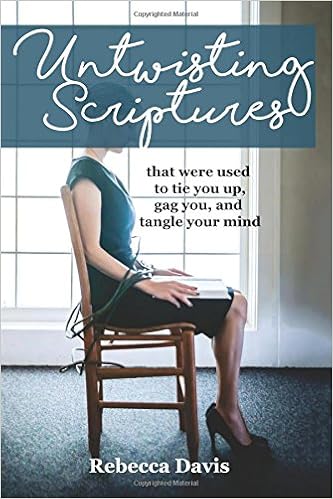
Untwisting Scriptures by Rebecca Davis takes a few “Christian” teachings that have been used to confuse and silence abuse victims for many years, and shows how they’re not even valid Biblical concepts. The book grew out of blog posts that Davis wrote as she learned more about people — mostly women — held captive by abusive theology.

Her tone is quiet and straightforward; she doesn’t indulge in snark or personal attacks. She doesn’t have to. All she has to do contrast actual Biblical context with actual teachings, such as this quote from the once-vaunted Bill Gothard from his 1984 Basic Seminar:

“Just because you are alive, you probably believe you have the right to be accepted as an individual, to express opinions, to earn and spend a living, to control your personal belongings, and to make decisions. You expect others to respect your rights.”

Spoiler: Gothard and the others quoted in this book don’t think you have a valid argument. Also spoiler: many of the people who teach these things either protect abusers, or are abusers themselves. Not a coincidence.

In this small book, Davis untwists a lot of strands. From the difference between human rights and human desires (looking at you, Nancy DeMoss Wolgemuth) to the fact that the Western church doesn’t know how to deal with grief and therefore labels it “sinful,” to the fact that we are supposed to take up the causes of the weak and abused and oppressed—there’s a lot to take in.

(And it’s not her fault that the chart on Page 59 made me want to fling the book away from myself in self-defense. I saw so many charts and graphs in my Bill Gothard days that they just look menacing to me, like the king snake that’s colored like a coral snake.)

Davis made one layout decision, based on early feedback, that vastly improves the reading experience. She set off the false teachings in gray boxes. It’s easy to identify the quotes she’s disproving… or, as she suggests, easy to skip over them entirely if you just don’t want to read the words. Even I, years away from that bondage, still felt the weight as I skimmed those twisty teachings.

I will say that this book targets a specific subculture. Those of us who sat under the teachings of Gothard, Bob Jones University, Nancy (Leigh) DeMoss Wolgemuth, and their ilk will recognize the phrases and terminology. Those outside of this small circle won’t find them as immediately recognizable. But these ideas permeate American evangelicalism. It’s a good bet you’ve encountered the teachings even if you don’t know the names and the terms.

Untwisting Scriptures came out in 2016, not even a year after I released The Fellowship. I mention the timeline because that’s why I didn’t pursue the book when I first encountered it. I was weary after years of struggling through twisted Scriptures. I thought, “So glad somebody is addressing these problems. I’ve already dealt with them. Time to move on.”

When Davis and I connected this summer over our books, I had “moved on” enough to come back to these concepts with renewed passion. So many others are still hurt and grieving. They need to hear a voice that untwists the bonds and gives freedom.

Rebecca Davis’ book is a voice like that. Check it out.

Realistic, Funny, Not Quite Perfect: A Review of “The Fellowship”

Rebecca Davis of Here’s The Joy reviewed The Fellowship. She thought it was engaging from the first page, funny, and realistic. And she found the ending satisfying… “in a way.”

But not entirely.

She definitely has a point. My novel does not explore a renewed relationship with Jesus. I made that a deliberate decision, mostly because I wanted to emphasize the fact that Bekah’s issues with God the Father were not because she wasn’t a “real Christian” who “didn’t know Jesus.” Also, her journey from the end of the last chapter to the beginning of the Epilogue could fill up another novel. I know this — my original Epilogues were longer than some of my chapters.

Still, after reading most of Davis’ blog, I see that missing element more clearly now. If I were writing the book now, I’d still make the same decision; but I’d bring out Bekah’s existing relationship with Jesus much more clearly.

I especially like how, in her review, Davis pairs my novel with a book that Bekah definitely could benefit from. It appeals to my sense of story arc, I guess.

Jump on over and read the whole review. Then stick around and read more of Davis’ excellent blog. She addresses twisted Scripture and how the church tends to protect abusers instead of their victims. My favorite category is “challenging the status quo,” where she takes apart not-actually-Biblical statements like “anger is sinful” and “Christians should yield their rights.”

And she actually wrote exactly the kind of book that Bekah (and the Bekah inside myself) needed when coming out of spiritual bondage: Untwisting Scripture. I’ll be posting my own review soon.

Have you read The Fellowship yet? You really should. It gets you absolutely no extra holiness points with God, but it will help you understand either your own past of spiritual abuse, or why someone you love is struggling. Click the link to get to Amazon, or contact me directly.


The Bible Bait-and-Switch

lures-537661_1280There’s a certain class of Bible teaching that is mostly about verbs.

Pray this prayer so God will bless you.

Follow these steps so God will protect you.

Hear and obey so God will listen to you.

The teachers in this camp claim to know the hidden ways of God, and they want to teach you to access these exclusive treasures. They usually have some kind of gimmick—a certain prayer, certain steps, a certain way to read your Bible. Then they bait-and-switch ideas to make you think that they’re teaching what God says when it’s really just what they’re selling.

I recently came across someone who sounds a whole lot like a “verbing” teacher. Now, I don’t know anything about Bob Sorge except his titles on Amazon and the Kindle sample of his book Secrets of the Secret Place. So I have no axe to grind or hatchet to bury in his head. I’m bringing him up because all it took was two chapters for me to recognize:

  1. The verb
  2. The gimmick
  3. The bait-and-switch

His verb is to Pray. (He also adds “hear” and “obey” later.) By “pray” he means to sit in quietness and solitude, reading Scripture, and listening for God to speak. Is that bad? No! I think it’s a very good practice to learn to sit in silence—one I’m not good at myself. The Verb is usually a good thing to do, and pray definitely qualifies.

However, he’s got to have a gimmick to sell his special knowledge of God’s hidden ways. Like any good Verbing teacher, he frames it with a Bible verse. I’ve parsed it out below:

Sorge (from his book Secrets of the Secret Place):
“But you, when you pray, go into your room, and when you have shut your door, pray to your Father who is in the secret place; and your Father who sees in secret will reward you openly” (Matthew 6:6).

…When Jesus taught on prayer, He gave primary emphasis to the secret place. In fact, the first thing He taught concerning prayer was the primacy of the secret place. In the verses following, He would teach us how to pray, but first He teaches where to pray.

My comment:
This verse, in context, is actually emphasizing the right attitude of prayer. Jesus is saying that we shouldn’t make a big public display of our prayers to show how holy we are, but to pray privately to God alone, without seeking the admiration of others.

Sorge:
Jesus affirmed this truth twice in the same chapter. He says it the second time in Matthew 6:18, “‘So that you do not appear to men to be fasting, but to your Father who is in the secret place; and your Father who sees in secret will reward you openly.’” Jesus says it twice for emphasis, so we know this word is absolutely certain.

My comment:
The key word here is fasting. Same point as the verse about praying. Don’t make a big holy display of yourself. Carry out your devotion to God quietly, seeking to please only him.

These verses have nothing to do with where your body is, but where your heart is.

Sorge:
Our Father is in the secret place! Furthermore, Jesus gives us the key to finding this secret place. If you’re wondering what you must do to place yourself in the secret place, Jesus made it clear. To get there, all you have to do is shut your door! When you enter your room, and shut your door, you are in the presence of your Father. Instantaneously!

My comment:
Hard to argue with that, but I’m also in his presence in the kitchen, at the mall, or stuck on I-81 in road construction. Finding God by going into a room and shutting a door… that, folks, is Sorge’s Gimmick.

Sorge:
It matters not how you feel. Regardless of your soul’s climate at that moment, you know with absolute confidence you have stepped into the chamber of your Father in heaven. The secret place is your portal to the throne, the place where you taste of heaven itself. Receive this word and you have gained one of the greatest secrets to intimacy with God.

My commentary:
And there you go! If you Verb, by way of his Gimmick, you gain a secret way to God.

They always have Scripture to back up their points, of course. Here’s the Bait-and-Switch where he leads you in with Scripture, and leads you right on out on his own hobbyhorse:

Sorge:
Cornelius was a devout Gentile who committed himself to the secret place of prayer.

My commentary:
The “secret place of prayer” wording is the author’s assertion, not actually taken from the Bible.

Sorge:
[Cornelius’] piety is described in the Book of Acts as fourfold: he gave regularly to the poor; he lived a holy lifestyle; he practiced fasting; and he adhered to the secret place of prayer.

My commentary:
I looked up this verse, Acts 10:2, and this is what it says: “He was a godly man, deeply reverent, as was his entire household. He gave generously to charity and was a man of prayer.”

It doesn’t say a “secret place of prayer.” Although I’m all for paraphrasing to keep things moving, this particular paraphrase is a seemingly innocuous, but very important, addition.

Sorge:
It was because of those four pursuits that God filled Cornelius and his household with the Holy Spirit and made them the firstfruits of all Gentile believers.

My commentary:
That’s the bait…

Sorge:
It’s as though God said, “Cornelius, because of your passionate conviction for the secret place, your life is the kind of example that I can reproduce in the nations.”

My commentary:
… and switch. He’s shifted from Cornelius and his four pursuits to a “passionate conviction for the secret life.”

Sorge:
…By making Cornelius the catalyst for the redemption of the nations, God was giving a powerful endorsement to Cornelius’s priority of cultivating a hidden life with God. The eruption of fruitfulness from his life must have caught even him off guard!

My commentary:
I feel like applauding. “Yay! That was so clever!” He so easily slipped in the idea that Cornelius was blessed by something that the author made up. Not only that, but God endorses it.

And he goes on to base the rest of his book (presumably, from the title) not on anything in the Bible, but on this idea of his about a “secret life with God.” Ideally, his audience doesn’t catch the shift, so they follow along thinking it’s all right there in the Bible. Even if they take the time to look it up, Sorge has taught them to equate “a man of prayer” with “a passionate conviction for the secret place.”

If this is how he justifies the very core of his teaching, then I’m extremely skeptical of what else he has to say. Anything he says about “hearing God’s word” now makes me suspicious, because what he claims is God’s word is actually his own. Anything he says about “obedience to God’s word” is a blazing red flag now, because if he can mold Scripture to fit his own ideas like that, then what does he think we ought to be “obeying”?

Following a teacher like this leads at best to disappointment, and at worst to bondage.

Pay attention to people who promise you a new way to access God. Watch for the Verb, the Gimmick, and the Bait-and-Switch. If you see it, then get up and leave the room. And shut the door behind you.

Marriage Mind Games

ball-1418250-1279x850A godly wife is submissive. A godly husband is a leader. This is the ideal model of marriage, as laid down by a God who likes making his children play mind games.

It’s not news that I’m no fan of the patriarchal/complementarian view of marriage. I sat through hours of the instruction as a teen. I even tried it when I first got married, with pretty terrible results. It causes more harm than good most of the time. But don’t take my word for it—here’s an article from one of the bastions of submissive womanhood, Above Rubies, with a rundown of how the game goes.

I found the article when someone shared it on my newsfeed, after Above Rubies posted it on their Facebook page. Considering that the working title of my novel was Somewhere Below Rubies, I’m obviously not the target audience. But it’s exactly the kind of stuff I was taught, and obviously still going strong.

You can read the whole thing here. Here on the blog, I’ll provide excerpts. With commentary, naturally.*

The author leaps into motion with the starting gun:

… God spoke to me and said, “Val, you cannot teach this message… Because you don’t understand submission!” Now I don’t mind admitting that I was shocked.

“Lord, do you realize that I’m Val Stares from Above Rubies? I’ve always encouraged submission.” “Yes,” was the reply, “but you still don’t know how to submit.” By now I was on the defensive. “But. Lord, you know that every time I want something, or desire to go somewhere, I always ask my husband first.”

“And what is his reply?”

“He says for me to please myself. Oh yes, he always adds, ‘You usually do.’ I don’t know why he says that because he’s already given me permission to do what I think best.”

Her husband’s reply is an interesting detail. Does he mean it casually, as a lighthearted way to say, “Yes!” or as an unstated resentful way to remind her that she doesn’t really care about his opinion? I’d think that God, who surely has as much basic education as a first-year marriage counselor, would suggest that she ask her husband what he’s really thinking.

But no. The patriarchal God rarely goes in for direct, heart-to-heart talks. That spoils the game.

“If you are serious about learning submission, Val, I want you to go to your husband and tell him that from now on he needs to answer you, “Yes” or “No.” If he says that you can please yourself, then you will take that as his disapproval and will stay home or go without. There is to be no pouting, no banging doors, no attitude of annoyance or hurt when this happens.”

So “God” has laid down the ground rules. Val runs out to the shed where her husband spends a lot of his time, and tells him her new revelation. He laughed—“You’ll never be able to do it!”

About three weeks later, a visiting speaker came to town.
Note the passage of time. Three weeks later.

Finally it was time to ask my husband if I could go. Out to the shed I went, told him what was happening and asked if I could go. As usual, I left everything until the last minute!
That little drop of self-blame is essential to the truly submissive woman’s worldview.

“Please yourself, you usually do.”
That’s how he answered. He didn’t say the magic words. Remember what he was supposed to say? “Yes” or “No.” Anything else meant he didn’t actually approve and she had to stay home. Because God said so.

I raced into the bedroom and pleaded with God, “He’s forgotten he has to say ‘Yes’ or ‘No.’ Can’t I just remind him?” “No” came the answer to my heart…
Because if you did that, it would totally ruin God’s fun.

Around the time I should have left for the meeting, my husband walked in to find me cleaning. “I thought you were going out to a meeting,” he said.
This is a major play right here. She explained how he had really forbidden her from going because he didn’t use the right words. And her husband got mad. He yelled at her that if she wanted to be so stupid and stay home, then fine, stay home!

It was then that the full revelation of what God was teaching me became clear.
I don’t know about you, but I’m revelating all over the place here.

I’m getting the impression that Val is an energetic, take-charge kind of person. Women who run ministries usually are. And she married a low-key, easygoing man. This is a perfectly normal and acceptable personality pairing—except in patriarchal/complementarian circles. In those circles, a take-charge woman has to force herself to be indecisive and subservient, but in order to do so, she’s got to compel her easygoing husband to order her around. However, according to God’s fun little game, she can’t say that.

So Val decided for some reason that her husband’s dismissive “Please yourself, you usually do” wasn’t up to par. She made up a code that he had to follow to show he was really leading her. Meanwhile, her husband thought he’d given her permission to do something she wanted to do, only to discover that she’d denied herself and blamed him. No wonder he was mad.

Oh, hang on. That’s not at all what Val concludes. Instead, she chalks up a major score in the mind game.

I had overridden my husband’s decision so many times that he was now robbed of any desire to lead. He must have felt so cheated. Now, by God’s hand, he was responsible for me staying home, but what hurt me most was the realization that it was me, the Christian wife, who had robbed him!
It’s a homerun, folks!

 My husband is a cautious man and rather slow at making decisions. My impatience at waiting for an answer caused me to make more and more decisions myself and he would go along with me for the sake of peace.
Or maybe he figured out a long time ago that you manipulate the situation to get what you really want, so his actual opinion didn’t really matter.

 I stayed home for several weeks after that, while we both learned our respective roles.
While he learned your official change in the rules, you mean.

So that’s the story part. Now she’s got to get into the doctrine part to justify why they dodge and block instead of talking things out like responsible adults. She quotes some usual verses on submission (Ephesians 5:22, Colossians 3:18) and adds all the usual explanations:

God is not telling husbands to make us obey or make us come under their authority. We do it because we love God and our husbands, and because He has asked us to. It is our choice.
Even though in her own story, she had no choice once “God” told her to do it.

In my mind I saw my broom raised to a horizontal position above my head. The handle was labeled, “My husband’s Authority.” I could see that if he were in his rightful position, I would be able to walk beneath it in an upright position. This upright position was one of honor, security, love–and a surprise I didn’t expect or notice until much later–power!

This is one of their favorite plays. They insist that a woman who doesn’t make any decisions on her own, but lets her husband dictate everything, is in fact very powerful. They point to Esther, who had enormous influence over the king. That’s the kind of influence a truly submissive wife has! All she has to do is go into every situation thinking, as Esther did, “I’ll ask him about this. If I die, I die.” What’s so hard about that?

Just because the things I wanted to do were good things, didn’t necessarily mean they were what my husband wanted to do. He could have other plans.
Not that she asked if he had other plans. Not that he told her he had other plans. They are very careful not to mess up God’s favorite sport.

But God wanted me to measure myself by the attitude of Jesus.

We read about Jesus’ example in 1 Peter 2:18-23, “For what glory is it, if when ye be buffeted for your faults, ye shall take it patiently? But if, when ye do well, and suffer for it, ye take it patiently, this is acceptable with God. For even hereunto were ye called: because Christ also suffered for us, leaving us an example, that ye should follow his steps…Who, when he was reviled, reviled not again; when he suffered, he threatened not; but committed himself to him that judges righteously….Likewise, (with the same spirit of Jesus) ye wives, be in subjection to your own husbands; that, if any obey not the Word, they also may without the word be won by the conversation (the manner of life) of the wives.”

This is actually what 1 Peter 2:18-23 says. It’s written to servants (slaves, as translated in the New International Version).

“18 Servants, be subject to your masters with all fear; not only to the good and gentle, but also to the froward.

19 For this is thankworthy, if a man for conscience toward God endure grief, suffering wrongfully.

20 For what glory is it, if, when ye be buffeted for your faults, ye shall take it patiently? but if, when ye do well, and suffer for it, ye take it patiently, this is acceptable with God.

21 For even hereunto were ye called: because Christ also suffered for us, leaving us an example, that ye should follow his steps:

22 Who did no sin, neither was guile found in his mouth:

23 Who, when he was reviled, reviled not again; when he suffered, he threatened not; but committed himself to him that judgeth righteously:”

It looks a whole lot like she tacked on 1 Peter 3:1, the verse about wives, without saying so. Not only is she quoting Scripture out of context, she just created her very own Frankensteinian context! Slam dunk!

What happened to that feared and dreaded “door mat,” the so-called intimidated mousy wife who gets no say? It was a lie. It had no substance or power. I can now stand up straight, and walk upright, secure and loved under his protection. On this side of submission, I have more say because my opinion is of greater value than before.
In a spectacular leap of logic, she concludes that by not expressing her opinion on anything, it has greater value. Touchdown, baby! GOOOAAALLL!

One word of warning– submission is a daily practice, not a one-time act. I have to daily check my attitude and the humility of my heart.
But it’s even harder to work every day at communicating with each other, balancing each other’s desires with your own needs, taking care of misunderstandings as they happen. No guarantees, no formula to fall back on—just love, effort, and God’s grace.

But in the long run, your marriage grows stronger when you don’t depend on formulas, but take the risk to meet as equals and face issues together.

We serve a God of grace.

Not a God of mind games.

Game, set, match.


*Should I apologize for the unholy mixing of sports references? That would suggest that I’m sorry for it.

Deborah: When Men are Weak

king-and-queen-1179013-639x462Apparently in some of the back streets of the internet, there’s a fight about whether movies should star “strong female characters.” The whole question makes me nearly sprain something rolling my eyes, so I don’t actually know much about it.


I did read a post on the subject, though. The author, a woman, wrote it in response to a man who objected to “strong females” in stories. He claimed that they usurped a man’s rightful, God-given place as the protector of the weak.

Among other points in her post, the author of the rebuttal mentioned the Biblical example of Deborah. And I thought, “You think you won a point. But you really lost it.”

The thing about Christian patriarchalists is that they know their Bible. They know it like Westley and Inigo knew their fencing forms. It’s kind of like a game, sparring with them. First they lay down the rules—you must argue from the Bible. Nothing else is authoritative. Then they show up with all their Bible knowledge and interpretation and demolish you. They know what you’ll say, and they’ve developed a reflexive response for it. Maybe, if you’re really good at holding your own, they might acknowledge—as Westley did to Inigo—that you’re an artist of stained glass window caliber.

But how is bringing up Deborah in a debate about female leadership an automatic loss?

Yes, we’re talking about the same Deborah, the Old Testament judge, whose story is found in Judges 4-5. She lived during the time before Israel had kings. The people listened to her for God’s words and judgements, especially during this time when a nearby king oppressed them.

Deborah sent for Barak, obviously a warrior of renown. She informed him that God wanted him to gather troops and go against the enemy general, Sisera, in battle. Barak kind of blanched at the thought and said, “I’ll go if you go with me.”

“Fine, I’ll go,” Deborah said. “But just so you know—you’re not going to get any glory from this. Sisera will die by a woman.”

So they went up together and Barak mustered his troops. They met Sisera in battle; it didn’t go well for Sisera. God routed his army, and he himself escaped on foot. He found the tent of an ally, whose wife—Jael—invited him in to rest.

(Jael is the stuff of nightmares to patriarchal men. She pretended to be friendly, waited till Sisera collapsed from exhaustion, and then drove a tent peg through his head.)

Israel won a definitive victory, and the entire next chapter is “the Song of Deborah and Barak.”

If you read the account straight through, you might not see where Deborah went wrong. That’s because you’re probably forgetting the most important principle for interpreting a Bible story about a woman: authority.

Who was in authority? It’s hard to get around the fact that it’s Deborah. She was even married but still looked to as the judge. But women aren’t ever supposed to be in authority over men, therefore Deborah’s judgeship was somehow not God’s best. Even though God doesn’t seem to have realized that.

The teachers I sat under pointed to the fact that Barak was so reluctant. If this warrior was too uncertain to go into battle without Deborah, what did that say about the men of the time? Exactly. They were all weak. That’s why there was a woman in charge—because there weren’t any good men to step up and do it.

So the story isn’t about Deborah’s strength, but Barak’s weakness. It’s not Deborah’s honor, but Barak’s shame. It’s not about a woman, it’s about a man.

And there’s obviously an element of that, since it’s such a point that the victory went to “a woman.” But without the Authority filter over it, the story in general kind of shrugs at the fact that Deborah’s in charge. The point is not woman or man, but God.

But if you find yourself locked in combat with a patriachalist over female empowerment, and the twisty logic, leaps to conclusions, and sheer vigor of his arguments have forced you to the wall—don’t bring up Deborah. He’s already got her properly boxed up and out of the way. All you will do is reinforce his point (to himself) that a strong woman is merely compensating for a weak man. A woman who is trying to be “strong” is therefore trying to “weaken” a man.

It’s right there in the Bible. Remember Deborah?


The Good Patriarchy

paper-family-ii-1176053-1599x987

Patriarchists aren’t all bad.

Statements like that sound charitable, but they’re usually not. For one thing, as soon as I start thinking of people as a generic group– “Fundamentalists” “Liberals” “Right-Wingers” “The Gays” “Rednecks” — I stop seeing them as real people. They (plural) become a faceless figure (singular) imbued with everything I dislike about their particular set of ideas.

So to say that Patriarchists aren’t all bad, I’m basically conceding that they might have some actual human qualities.

My point here is much more generous, I hope.

People embrace a Christian patriarchal worldview for real reasons. The world has problems, and everyone is looking for solutions. As I once heard it said, “I like the questions they ask. I just don’t like all their answers.”

Here are some good reasons why people are “Patriarchists”:

Men need respect. (Yes, and also love.)  This is especially true for that almost invisible population of men who aren’t particularly handsome or flashy, nor are they violent and oppressive. They’re devoted to those they love. They work hard, worry a lot, do the best they can to provide and protect. You will find these men all through the ranks of the patriarchy camp. They’re sincere and faithful. They deserve respect. In a patriarchal system, they get it.

Women should plan their futures with motherhood in mind. Obviously I’ve got strong opinions about women’s education and future. But if a woman has any desire at all to have children, she needs to factor that into her plans. She has no idea beforehand how pregnancy will affect her. She could be on bedrest for six months, throwing up for nine, or simply too sleepy to function after 5pm. And it’s simple fact that mothers usually take on most of the work during the baby and toddler years.It’s smart to learn time management, childcare, and cooking. It’s also smart to look for a man who will be able to provide for the family if motherhood knocks her off her feet for a while. Patriarchy has this foresight built into its system.

Structure provides security. Life is scary and unpredictable. If you’ve already got a framework for handling decisions and expectations, it gives you something to fall back on. My dad died when I was three, leaving my mother with five children. But in that small Southern society thirty years ago, it was understood that the men of the family would do all they could to take care of the women. My grandfather and uncle stepped in and filled up a huge, gaping hole in our lives until my mom got back on her feet. In patriarchy, the men are accustomed to stepping up.

Men and Women (in general) are different and need one another for balance. I know, I know, not all women are highly emotional, and some men stop and ask for directions. Male/female stereotypes cease to be helpful very quickly. Still, there are obvious biological differences, and as a group, women and men approach life differently. A world with both masculine and feminine influence is a rich one. Patriarchy recognizes these differences in a positive light.

God pervades everything. In Christian patriarchy, there is no real distinction between secular and sacred. Everything you do is in service to God. You eventually go through everyday life in a constant awareness and communion with God.

I sincerely believe these things are good. So why don’t we want to return to the world of patriarchy?

Because it is not a self-correcting system.

As long as you get good people who are willing to compromise, be flexible, and understand other points of view — patriarchy can function very well for the people involved.

But if things go bad, the people under authority have no way to check or challenge the people in control. And it’s not really an “if”– when humans are involved, things will go wrong.

So Patriarchists aren’t all bad. I fight against the error of villainizing those who don’t see things my way. But I can look at a system that allows bad people to stay in control, and I can say: That is not good.


Abigail, A Dangerous Woman

The Bible doesn’t pull any punches when it comes to exposing dangerous women. The first one who comes to your mind, just like mine, is Abigail.

Lest you think we’re talking about two different Old Testament characters, I’ll give a rundown of her story. It’s found in 1 Samuel 25.

In the years before David became king of Israel, he was on the run from Saul–the current king–and building up his own following. They happened upon the fields of Nabal during shearing time. David sent ten men to Nabal saying, “Hey, we didn’t mess with your shepherds or steal any of your sheep or goats. So could you give me food for my men?”

It was a big request. But Nabal was a rich man. More to the point, he was still rich thanks to David’s honorable treatment of his property. Also, David’s men had weapons. Like any reasonable man, Nabal saw that it was to his advantage to pay up his part of the bargain.

Oh, wait. Nabal’s name means “fool.” He did not pay up. He insulted David and told him to get lost.

David got mad and began mobilizing his men for wholesale slaughter of every male in Nabal’s household.

(See, class? We sure do need for men to be in charge all the time because it always goes so much better that way.)

Abigail was Nabal’s wife. When a servant came to her in a panic, telling her what was going on, she swung into action. She gathered up food, freshened up, saddled a donkey, and went out to meet David herself. She apologized for her husband’s foolishness and begged him to spare the household.

David, hotheaded though he was, was actually a reasonable man, especially by ancient warlord standards. He agreed to call off the attack. In fact, he was relieved that Abigail had kept him from unnecessary bloodshed.

Abigail went back and told Nabal what she’d done. Nabal was furious. So absolutely, intensely furious that he had a stroke and then died.

So the household was saved, Nabal disposed of, and David took Abigail to be his wife. Which really was the best a woman could hope for in that time.

Okay, so I admit that at first glance, it actually looks like Abigail is the hero of this story. But one of the tricks of a patriarchal worldview is that it can use one or two details to twist the whole perspective into the proper shape.

To start with, you’ve got to keep the most important principle in mind at all time. That principle is: Authority. Every situation, even a story told for centuries around campfires, must be filtered through the grid of Authority.

Who was in authority in this story? Well, David, because he’d been anointed the next king of Israel. Who else had authority here? Nabal, the husband and owner of the property.

Who did not have the authority to make any decisions or take any action? Abigail. Because she was married, she was bound to obey her husband no matter what.

There are two telling details in the passage of Scripture. One, the servant came to Abigail behind Nabal’s back, and even said he was wicked and foolish. Abigail did not rebuke the servant for speaking against their authority. Two, Abigail made her plans and headed out to see David, but as the story notes, She did not tell her husband.

But… but… she spared every  male in the household! Including Nabal’s worthless hindquarters!

Yet you see what her rebellion–yes, she was rebellious–led to. Her husband died. David might feel like God had vindicated him, but Abigail had to live with the knowledge that her actions killed her own husband.

But… but… Abigail became David’s wife…

Pfft. She became one of his wives. Who wants that? (What woman had a choice back then? Hush, you’re cluttering up the narrative.) And she did have at least one son who should have become king after David, but we never hear anything about him. That’s the third devastating detail in this story: God punished Abigail by not letting her son become the next king.

I’m not exaggerating this interpretation. This is what I was taught as a student of Bill Gothard. He embroidered a lot of the details*, but there’s a long tradition among hardcore patriarchalists to demonize Abigail. She usurped her husband’s place and was the cause of his death.

Girls, do not grow up to be like Abigail!

You should instead hope to be like… well… how about you just don’t read ahead in your Bibles until we have time to explain how Ruth, Esther, Deborah, Jael, etc. are also cautionary tales. Here, instead we’ve rewritten history and also these stories with passive obedient heroines. We’ll get back to God’s Word when you’re ready to understand the truths hidden within it.

Good thing you’ve got men to illuminate it for you.

*Gothard claimed that if Abigail hadn’t intervened, then David would have had the guilt of unnecessary bloodshed on his conscience; years later, when he got Bathsheba pregnant, he wouldn’t have sent Uriah into battle to be killed because he’d already know how wrong that was. I didn’t make that up.

** I hope it’s clear that I’m not claiming all Christian men believe this way. But there’s a slice of Christianity that does. If you’ve never encountered teachings like this, you might not realize the enormous effort it takes to re-read the Bible in its own words, not the twisted interpretation we were given.

Orderly Umbrellas

3050_10201307520445888_2703518072495550916_n

“So pastors are under God’s authority,” Bekah explained. “Families are under the pastors.” She held her hand in the air and moved it down levels as she spoke. “Husbands are in authority over wives. Wives are in authority over children.”

When Ty didn’t respond, Bekah added, “It’s all very orderly, anyway.” But of course Ty didn’t give “orderly” as much weight as she did. In the Fellowship, orderliness was nearly one of the Ten Commandments.

The FellowshipChapter 5.

The “umbrella of authority” is a concept that’s been around for many years. I was taught this very “order” as a teenager, although the charts I saw weren’t illustrated with patio umbrellas. It gives it kind of  an easy-living vibe.

It’s a clean, logical graphic that makes its point with a single glance: The Umbrella of Authority concept effectively protects Jesus from getting cooties from women!

Haha, not really. We all know that in Christ, men and women can approach God as equals. So this chart isn’t saying that a woman can’t get to Jesus except through her husband.

Of course, if you look at the husband’s share of life responsibilities, you’ll see that he’s supposed to be the spiritual leader. And underneath the woman’s cute little umbrella, you see “Submit to husband’s authority.” So a woman could approach God on her own, but to be honest, that really does mess up the Natural Order of the Family, doesn’t it? And God is a God of order, so he actually prefers you to go through the proper channels.

So… just go through your husband, okay?

There’s certainly nothing here that a man could object to. Shouldn’t a man lead his family spiritually? Shouldn’t he provide for his family? Shouldn’t he love his wife?  Well, then, what’s the problem?

What do you mean, these responsibilities don’t have to be limited only to husbands?

Oh. Hold on. We need to get something clear here.

You can’t shift these categories around. The umbrellas are impermeable when it comes to proper roles and responsibilities. You let a woman provide for the family or exert spiritual leadership, and the next thing you know, the husband will submit to her authority on some issues, and that’s it. The umbrellas disintegrate in a fiery, bloody, toxic meltdown.

This catastrophe completely incapacitates men. They won’t read their Bibles, won’t hold a job, won’t take out the garbage, nothing.* But they probably will look at porn and run away with another woman (probably some woman who usurped her husband’s authority, destroyed her home, and is now going to destroy yours). Why would you even want to mess with that?

No, this is the Natural Order of the Family. It looks great and worked really well in Victorian times, assuming you happened to be white and middle- to upper-class.

Just go with it.

Just hush.

Just obey.

It’s the Natural Order of the Family.

*Very recently, I read an admonition written by a man to younger women, advising them on how to find good answers to their questions. He explained that they were, first of all, to read their Bibles. Then they were to ask their husbands any questions they had. Don’t worry if you, the wife, knew more about the Bible than your husband did; your questions would motivate him to study! But the flipside is that he won’t read his Bible at all if you bypass his authority and seek out answers on your own.

I heard this same idea very often growing up. Men in patriarchal circles are badly prone to wind down to complete nothingness if their wives aren’t there to motivate, bolster, and reassure them that they are big strong leaders.

**By the way, why doesn’t Jesus have to do anything in this umbrella system?

***Seriously, it’s like its all dependent on our own works or something.


The Patriarchy Shop

The smiling man, dressed in a tailored dark suit, leaned over the polished oak and marble counter. “Welcome to the Christian Patriarchy Market! How can I help you?”

His new customer, a young woman, smiled tentatively back. “Hi. I’m looking for a new one of these, and I was told I had to get it here.”

She laid a large purse on the counter top. It was dark leather with “life” stamped on it in faded yellow letters. “I just turned twenty-two. I feel like I’m ready for a bigger one.”

His smile broadened. “I’ve got exactly what you need!” He opened a cabinet and withdrew another bag. It was much larger, and engraved into its smooth leather surface in flowing silver letters was Life.

“This is ideal for a woman in your situation,” he explained. “See how much bigger it is. You’ve got a lot more space to serve others. There’s a special pocket here to store your heart — I assume you’ve got it locked away in a box and you’ve given the key to your father?”

“Well…” she said hesitantly.

“Because you’re ready for a lot more responsibility, you’ll see that this one has lots of different sections. Here’s where you put your church ministry, here’s where you add your advanced homemaking skills, and don’t forget to fill up this baby pocket with lots and lots of longing! You’d be surprised at how many women in your stage of life don’t give any thought to wanting babies, but you can’t start too soon.”

She examined the bag with interest. “It’s really lovely, but I’m not sure it’s everything I need. I really, really love working in the yard…”

“You can put that with homemaking skills!”

“… and I’m really good at organizing events…”

“Church ministry! But you’ll need to tuck it way down so it doesn’t spill over into all the rest of the bag.”

“And… to be honest, I really want to learn to fly a plane. I’ve kind of looked into being a private pilot.”

The man paused. Then he cleared his throat. “I don’t think there’s really room for something like that. You could get your father to authorize an add-on for missions, but I’ll be honest with you, it’s bulky and doesn’t really fit.”

“But my brother’s accommodates all of that!”

“The men’s line is designed a little differently, of course.”

She fingered the soft leather. “I’d noticed that. Well, anyway, this won’t really work for me, because I’m getting married this summer.”

The clerk’s face lit up with excitement. “Really? Oh, you should have told me that to start with! You don’t need this old thing.” He swept the bag off the counter. Opening another cabinet door, he withdrew a leather bag so large that it took two arms to lift it onto the counter top.

It was made of leather, dyed deep red and purple, and fastened with brass. Surrounded by intricate scrollwork were real gold letters spelling out LIFE.

“This is everything you need!” the clerk exclaimed. “Look at this capacity–you’ll never run out of space for your desires! Lots of room for serving, huge section here for children, just look at your household work space! And right here–almost the entire middle section–is dedicated to your husband. You’ll have a lifetime job just filling this up!”

He looked at her expectantly, but she didn’t seem to share his enthusiasm. “There’s no room here for piloting a plane. Or organizing events. What about knowing God? I was hoping that my new bag would have a lot of space for that.”

“That’s the great thing about the patriarchy design,” the salesman said. “Watch this.”

He walked around to the front of the counter and opened two large double doors on the front. Using both hands, he extracted a rolling leather bag, reinforced with steel and decorated with images of swords. “This is the married man’s bag. It’s extra-double capacity because once a man is married, he’s basically responsible for everything relating to his wife and family. Pretty hefty weight to carry. Aren’t you glad you don’t have to worry about all this?”

“Well, I could help carry it.”

“Oh, no! This isn’t designed for a woman! But let me show you the best feature here.” He opened the man’s bag. Then he picked up the woman’s bag and tucked it inside. “See? It fits right there in the section for ‘spiritual maturity.’ As long as you keep all your things there, you’ll know everything you need to about God.”

She pointed to a small zip pocket on the side of the woman’s leather bag. “What’s that for?”

The salesman’s smile was bright. “You just stuff all your bad feelings in there and zip it up. That’s the feature that makes our design workable.”

The woman stood silently, taking it all in. Then she burst out, “But I don’t want to put all my stuff in there! And that’s way too heavy for my fiance! What happens if I have too much to fit? Or if his bag tears open?”

The clerk was no longer smiling. “I thought you were a serious customer.”

“I am! There’s just some serious flaws in your design.”

“Excuse me. It’s not my design. It’s God’s design. This is the way it works. You can go shopping at some other bag shop, but I warn you, those are badly-made and will rip open at a moment when you’re least expecting it. You’ll lose everything.”

She cleared her throat. “Just curious… have you ever used the woman’s bag to see how it really works?”

The salesman gave a short, derisive laugh. “Well, no. I don’t think God even uses it. He’s male too, you know. So, can I ring you up?”

“I… think I need to think about it.”

“I warn you, if you walk out of here, you walk away from this exclusively-designed line and away from the God who designed it!”

The woman shouldered her small bag again. “I think I saw God in some other places. He really seems too big to fit in here, actually. And so am I.” She turned and walked out of the shop.