A Reading List

So if you happen to be somebody who writes about spiritual abuse and recovery from legalism (just as a random category), you probably have a huge personal library of books on the subject, right?

Well, I guess so. If you’re not me.

I haven’t actually read piles of books on the topic. I seek out actual personal accounts. I also tend to find themes of self-empowerment, grace, and freedom in books that don’t have anything to do with cults.

But there are a few particular books that stayed with me and influenced how I wrote The Fellowship. You might enjoy the same elements I did.

**

The Gift of Sarah Barker, Jane Yolen.
I discovered this book when I was a teenager. I don’t remember many specific details, just that it hit me deeply.

Set in the 1800s, it’s the story of a teenage girl, Sarah, whose mother brought them into a Shaker cult (not to be confused with the Quakers, a completely different sect). This sect taught that sexual love in any form was sinful—they didn’t even allow marriage. (Not surprisingly, the Shakers died out, although Aaron Copeland immortalized their catchy tune “Simple Gifts” in his Appalachian Spring.)

Sarah tries very hard to fit into the sect; but her imagination, her longing for a life beyond, and her attraction to one of the young men keep sabotaging her own efforts.

This book could have been a story of oppression and sexual darkness. But Yolen instead showed many warm moments in the community. It wasn’t all bad; I understood why Sarah doesn’t really want to leave until she has no real choice.

The book seems to be out of print now, which is a shame. It’s worth tracking down.

When Sparrows Fall, Meg Moseley
I don’t like Christian fiction in general. The genre tends to feature flat characters, trite storylines, and pre-packaged answers. Several years ago, I opened Sparrows expecting more of the same.

I was very happily disappointed.

This is the story of Miranda, a young widow with several children whose pastor has decreed that their church is relocating to another state. He pressures her to sell her property, give the money to the church, and move with the rest of the congregation. Miranda has spent her whole married life being a submissive woman, but she digs her heels in and won’t sell.

Then she suffers a bad fall. In the city a few hours away, her brother-in-law, Jack, gets a call saying that he’s been named guardian of the children while she recovers.

Jack shows up to do his duty by his half-brother’s family. He quickly gets drawn into the weird world of Miranda’s church. He challenges the church’s beliefs, goes out of his way to help her and her family (and oversteps the line a couple of memorable times), and eventually finds out the secret that keeps Miranda tied to her house and her life.

I fell in love with Jack, grieved and then cheered with Miranda as she rediscovers herself, and identified with much of the spiritual abuse. I finished the book with new inspiration. If this was Christian fiction, then I could write it. Specifically, I could write that story inside me that just kept eating at me.

The Devil Wears Prada,* by Lauren Weisberger
I happened upon this book, having heard nothing of it, and pretty much inhaled it. At the time, I wasn’t really sure why it drew me in and then stayed with me. I don’t care about the world of high fashion and I didn’t have grand ambitions to work for New York magazines. The main character — although about my age when I read it — lived such a different life from mine it was laughable. (She sleeps with her boyfriend before they’re married? She has her own apartment in the city? She wears pants and sexy clothes without worrying about modesty?)

Years later, I understood its appeal to me. The book shows how a well-meaning person can get trapped in a subculture where everyone obeys an all-powerful leader. And not just trapped, but voluntarily submitting to it–even while hating parts of it. It also showed the fallout among those she loved. Her choices came with a real price.

All that said, I remember this book as a pretty light read with some pretty funny spots.

Ella Enchanted*, Gail Carson Levine
This retelling of Cinderella is one of my all-time favorite books. Ella was “blessed” by a fairy with the gift of “obedience.” She must obey any order given to her. Obviously this presents small problems — anybody can boss her around — and very large problems — anybody can order her to kill, steal, and destroy. She keeps the curse a deep secret. But things get complicated when she befriends and then falls in love with Prince Charmont… and then her malicious stepsister finds out the secret. She has to cut off all contact with Char for his own protection, and then must find a way to break the curse.

This book plays into the cult theme with the idea that Ella must obey, but finds little ways to get around it just to retain her own self. It’s also got some of my favorite lines in it, like, “I’m afraid of heights. And it’s only gotten worse as I’ve gotten taller.”

Girl at the End of the World , Elizabeth Esther
Several years ago, I followed Elizabeth Esther’s blog. I knew she grew up in her grandfather’s cult. Compared to what she went through, my experience was Lite Spiritual Abuse with Low Sodium and No Added MSG.

I also knew she wrote a memoir of her experiences. But I was immersed in writing my own book, and besides, I knew hers would hurt to read.

I should have trusted the blogger I knew back then. Elizabeth writes honestly with a twist of snark that makes it all easier to take in. Her experiences were painful—I am still cringing before Grandma Betty’s ice-blue eyes that demanded complete broken submission about once a week. But Elizabeth also gives moments of beauty, like when she and her husband first connected under a sky of stars. She highlights a few bright, caring people who passed through her life and left a mark of grace on her.

Girl is quick read, except for the frequent necessary pauses to put down the book, dash outside, and breathe in a big gulp of fresh air. As I read it, I was struck by the parallels between her “Assembly” and my “Fellowship”—the fear, the control, the in-jokes, the tight community, and the secrecy.

**

These books helped me understand and process the world I came out of. After all, it doesn’t matter what the outward trappings are; if a system has one person in authority with no accountability, they all operate from a rotten core.

And here’s to recovery that involves good dialogue, a tight story, and no out-of-context Bible verses.


*Movie? What movie? I ignore movie versions of books I like.**

**Except The Help, which was well done. Hunger Games was all right, although I saw only the first one. I liked the first two Narnia movies, hated the third one. Divergent was a disaster. I saw all of the Harry Potter movies, but I won’t sit through them again. I watched all nine hours of The Lord of the Rings twice, and God says I don’t have to watch them again.
Are You a Failure? Y/N

The thing about cults and cult-like systems is that, for the most part, they’re really boring.

Most of the indoctrination takes place day by day, through sermons that carefully redefine Scripture, through lectures that reinforce the group’s beliefs, and through long, dull sessions of filling in blanks and regurgitating the right answers.

The question-and-answer exercises are very simplistic, and all designed to condition you to doubt yourself and feel like a failure. You learn to look to your leader for answers, and you’re afraid to leave the group because you know you’ll crash and burn on your own.

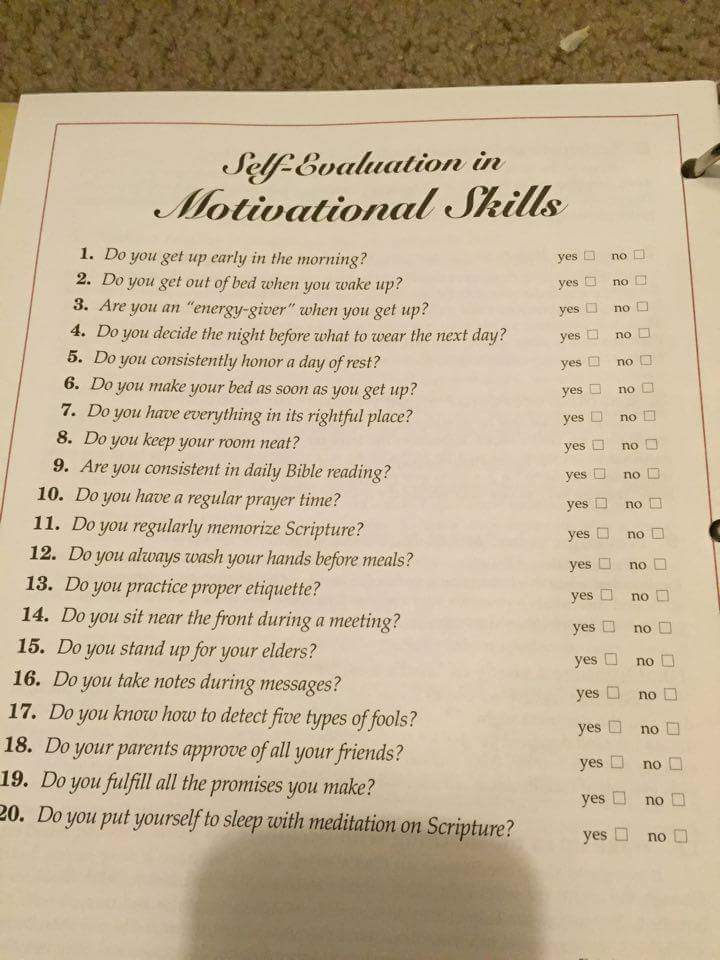
A friend from my own Fellowship* recently shared a snapshot of a worksheet we had to fill out as students in the early 90s. As 14 – 18 year olds, we were separated from our parents at weeks-long conferences, awakened early and kept up late, and bombarded all day with lectures and conditioned group responses. Somewhere in the middle of this exhausting, bewildering, and exhilarating experience, they dropped things like this in our laps:

received_10153698897882180

1. Do you get up early in the morning?

2. Do you get out of bed when you wake up?

3. Are you an “energy-giver” when you get up?

4. Do you decide the night before what to wear the next day?

5. Do you consistently honor a day of rest?

6. Do you make your bed as soon as you get up?

7. Do you have everything in its rightful place?

8. Do you keep your room neat?

9. Are you consistent in your daily Bible reading?

10. Do you have a regular prayer time?

11. Do you regularly memorize Scripture?

12. Do you always wash your hands before meals?

13. Do you practice proper etiquette?

14. Do you sit near the front during a meeting?

15. Do you stand up for your elders?

16. Do you take notes during messages?

17. Do you know how to detect the five types of fools?

18. Do your parents approve of all your friends?

19. Do you fulfill all the promises you make?

20. Do you put yourself to sleep with meditation on Scripture?

*

An outsider could glance over it and say, “Well, there are a lot of great ideas here. Except what does washing your hands have  to do with self-motivation? Just take what’s good and leave the rest.”

An insider knew much better than that.  “No” is not an acceptable answer to any of these questions. Notice that”Sometimes” isn’t even an option. We couldn’t take-and-leave. This wasn’t a mere list of ideas. This was a test, and we were set up to fail it.

Unless you’re educated in the culture that it comes from, you probably still miss how loaded some of these questions are. I could spend a dozen blog posts unpacking these questions.

For instance, “Do you get up early in the morning?” Early rising was a mark of Godliness; sleeping late was, therefore, sinful. The next question, “Do you get out of bed when you wake up?” reinforces the idea that staying in bed is a sign of slothfulness. And there was an entire booklet about the dangers of being slothful. So if you answered “no” to questions 1 & 2, you’re already spiritually defective.

Or how about #14? Sitting in the back of a meeting demonstrated apathy (a sin) or rebelliousness (a major sin).

In order to answer #17, you had to remember the extensivelesson on the Five Types of Fools; so that question actually covered an entirely separate session in itself.

Question #18 weighed about a ton. Your parents had the power of God’s disapproval in your life. If they didn’t like a friend of yours, no matter the reason, the only obedient course of action was to get rid of that friend. Also, “friend” here could stand for “friend of the opposite sex” — someone you liked despite the fact that God expected you to keep your emotions pure until He brought you the one you were to marry. It was a reminder that even your emotions were subject to God/your parents.

The entire list, by the way, is pretty easy to master if you happen to be someone exactly like the Venerated Leader who wrote it — a man who didn’t need much sleep, was an extrovert, found memorization easy, didn’t have any real friends, wore basically the same thing every day, and spent thirty years sexually harassing young women that he invited to work for him. Oh, wait, he forgot to add that item, didn’t he?

Twenty years later, when many of us saw the picture of this list, we felt that same oppression we’d lived under as teenagers. “No wonder,” we said. “No wonder I always felt like a failure. No wonder I worked myself into chronic fatigue. No wonder I broke down at age 20.” This list was just one of many others like it. This was how we knew to please God.

This was our spiritual life, one in which choosing your clothes the night before is just as important as keeping the Sabbath (one of the Ten Commandments). No room for mistakes or personality. Just keep your head down, obey, and pretend you aren’t the complete failure you know you are.

And for the record, I have no idea how washing your hands before every meal made it on this list. That’s stupid.

If you need me, I’ll be lying in bed in my comfortably cluttered room, with no memory of the five types of fools, and resting in the grace of God.

*Bill Gothard, IBLP/ATI

My Story

Anybody can tell that I had a rough church experience, considering that I wrote a novel about it.

But actually — it wasn’t.

I grew up in a pretty normal Southern Baptist church in south Mississippi. It was conservative, but not particularly strict, legalistic, or reactive.

(But, being good Baptists with an “invitation” at the end of every service, we could sing “Just As I Am” seventeen times in a row without breaking a sweat.)

When I was 14, my parents decided to homeschool my sister and me. As far as the homeschooling went, I liked it. It suited my self-paced, nonconformist personality much better than the public school system.

So: church was okay. Homeschooling was fine. Then where did I get this novel?

Well, in order to homeschool, we got into Bill Gothard’s ATI program (made recently famous by the Duggar family, but we were before their era.) ATI seemed like a good idea at the time. Most cults do.

Over the course of two or three years, my family adopted dramatically different rules about dress, music, food, and romance. Many of the changes were painful for me. With every new publication or seminar or meeting, I knew something else I enjoyed would turn out to be wrong somehow. The “standards” were set high and left nothing up to personal choice.

But I conformed. After all, my other option was God’s punishment.

And my experience with the Institute wasn’t all bad. (Why, no, there’s nothing unsettling about the fact that we considered ourselves as part of “The Institute.”) I made a lot of friends, got to travel some, and was generally treated well — if mostly overlooked — by the leadership. The good was tangled up with the bad to the point that I couldn’t always tell one from the other.

Then I got married, and all those “standards” about dress and romance and music didn’t really seem important anymore. I was glad to leave it all behind.

Well, mostly behind. During the early years of my marriage, I was drawn to stories of cult survivors. Not people who escaped the weird, terrifying cults run by Jim Jones or David Koresh. No, I used my slow dial-up internet connection to find stories of people who left the big, visible, “churchy” cults that looked almost normal on the outside. These people had no real abuse to report, but were emotionally and spiritually devastated. Over five or six years, I read hundreds of heartbroken stories. Some ended in redemption, but all too many didn’t.

Then Facebook dawned and I connected with other ex-Institute students. I recognized those same cult-survivor stories in my very own circle.

And some of them in my very own life.

Gradually I faced my tangled memories. I finally understood how much pain I was in, but had been taught to ignore.

And I was one of the lucky ones. Many of my fellow “Xers” suffered tangible abuse at home, at church, or from Institute leaders. Some survivors were cut off from their families and hadn’t seen their siblings for years. All of us had to deal with a warped view of God, self-hate, and utter confusion over what the truth really is.

For me, redemption came through my marriage to a gentle, faith-filled man; through family and friends who loved me through the tangle; and finally, through a God who broke past the fear and pain and showed me what grace really is.

So my personal story isn’t too horrifying. I’m just someone who got chewed up and spit out by the system, without anything to show for it afterward. Nothing except a tenacious grip on God and a burning desire to give a voice to those who are still too broken to speak.

Warding Off Superstition

A couple of friends have pointed out that my launch date (ahem, November 13, ahem) is, in fact, a Friday the 13th.

And that’s kind of like poetic justice because nobody in the Fellowship is superstitious. God controls everything, so there’s no such thing as “unlucky days.”

Instead, Fellowshippers (and a lot of Christians outside of fiction) adhere to straight Biblical truth about cause-and-effect:

10989451_977357745657960_5766566684478885014_n

But saying bad luck is because we don’t complete certain rituals to ward off evil? Utter malarky.

Answers, in Novel Form

Why would you read this book?

Well, besides the fact that it’s a good story, it’s got realistic characters, and some pretty funny lines (if I may say so myself)?

Right, besides that. The novel isn’t just entertainment, nor is it revenge for the hurts of my past. I wrote it to answer some of the questions that all of us from this background encounter all too often.

It was already in the final stages of editing when Josh Duggar from “19 Kids and Counting” turned up as having serious sexual issues underneath the respectable clothes and boyish face. Those of us who knew how he grew up weren’t really surprised, but a lot of others were. And we started hearing those questions from a much wider audience.

They run along these lines:

  • Why do people get involved in cults?
  • Why do people stay once they realize something is wrong?
  • What’s wrong with a woman wanting to be “just” a wife and mother? Look at [fill in blank of wife of patriarchal figure]. She’s obviously happy!
  • Why won’t a woman in a system like that leave her cheating or abusive husband?
  • Why can’t they move on from the spiritual abuse? Can’t they “eat the meat and spit out the bones”? Why do they always try to throw the baby out with the bathwater?

The Fellowship attempts to answer these questions. The story shows the effect that an authoritarian culture has on its members — and how the system is designed to protect itself at the expense of anything (or anyone) else.

Of course, one novel can’t fully answer all these questions. My own experience is far too limited to do them justice. I chose to illuminate what it’s like to be part of an almost-normal cult. No dark rituals or demonic encounters. Just your basic selfish, abusive humans. Just an angry, distant deity ready to punish you if you step out of line.

So if you’ve ever asked any of those questions, or ever tried to answer them… well, there you go. That’s why you’d read this book.

And there are some good lines in it, too.

******

The Fellowship will be released on November 13. Click on the title to preorder your copy!