Orderly Umbrellas

3050_10201307520445888_2703518072495550916_n

“So pastors are under God’s authority,” Bekah explained. “Families are under the pastors.” She held her hand in the air and moved it down levels as she spoke. “Husbands are in authority over wives. Wives are in authority over children.”

When Ty didn’t respond, Bekah added, “It’s all very orderly, anyway.” But of course Ty didn’t give “orderly” as much weight as she did. In the Fellowship, orderliness was nearly one of the Ten Commandments.

The FellowshipChapter 5.

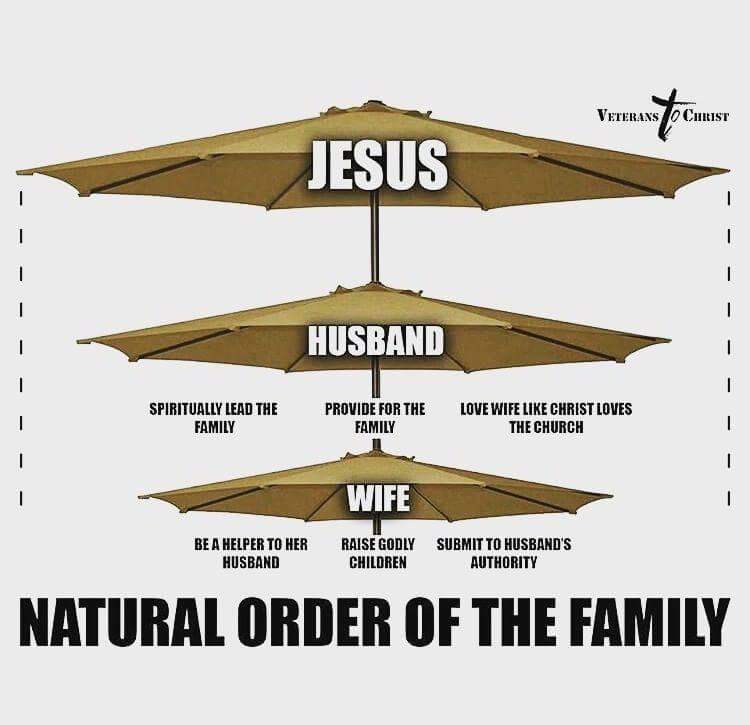
The “umbrella of authority” is a concept that’s been around for many years. I was taught this very “order” as a teenager, although the charts I saw weren’t illustrated with patio umbrellas. It gives it kind of  an easy-living vibe.

It’s a clean, logical graphic that makes its point with a single glance: The Umbrella of Authority concept effectively protects Jesus from getting cooties from women!

Haha, not really. We all know that in Christ, men and women can approach God as equals. So this chart isn’t saying that a woman can’t get to Jesus except through her husband.

Of course, if you look at the husband’s share of life responsibilities, you’ll see that he’s supposed to be the spiritual leader. And underneath the woman’s cute little umbrella, you see “Submit to husband’s authority.” So a woman could approach God on her own, but to be honest, that really does mess up the Natural Order of the Family, doesn’t it? And God is a God of order, so he actually prefers you to go through the proper channels.

So… just go through your husband, okay?

There’s certainly nothing here that a man could object to. Shouldn’t a man lead his family spiritually? Shouldn’t he provide for his family? Shouldn’t he love his wife?  Well, then, what’s the problem?

What do you mean, these responsibilities don’t have to be limited only to husbands?

Oh. Hold on. We need to get something clear here.

You can’t shift these categories around. The umbrellas are impermeable when it comes to proper roles and responsibilities. You let a woman provide for the family or exert spiritual leadership, and the next thing you know, the husband will submit to her authority on some issues, and that’s it. The umbrellas disintegrate in a fiery, bloody, toxic meltdown.

This catastrophe completely incapacitates men. They won’t read their Bibles, won’t hold a job, won’t take out the garbage, nothing.* But they probably will look at porn and run away with another woman (probably some woman who usurped her husband’s authority, destroyed her home, and is now going to destroy yours). Why would you even want to mess with that?

No, this is the Natural Order of the Family. It looks great and worked really well in Victorian times, assuming you happened to be white and middle- to upper-class.

Just go with it.

Just hush.

Just obey.

It’s the Natural Order of the Family.

*Very recently, I read an admonition written by a man to younger women, advising them on how to find good answers to their questions. He explained that they were, first of all, to read their Bibles. Then they were to ask their husbands any questions they had. Don’t worry if you, the wife, knew more about the Bible than your husband did; your questions would motivate him to study! But the flipside is that he won’t read his Bible at all if you bypass his authority and seek out answers on your own.

I heard this same idea very often growing up. Men in patriarchal circles are badly prone to wind down to complete nothingness if their wives aren’t there to motivate, bolster, and reassure them that they are big strong leaders.

**By the way, why doesn’t Jesus have to do anything in this umbrella system?

***Seriously, it’s like its all dependent on our own works or something.
 

The Patriarchy Shop

The smiling man, dressed in a tailored dark suit, leaned over the polished oak and marble counter. “Welcome to the Christian Patriarchy Market! How can I help you?”

His new customer, a young woman, smiled tentatively back. “Hi. I’m looking for a new one of these, and I was told I had to get it here.”

She laid a large purse on the counter top. It was dark leather with “life” stamped on it in faded yellow letters. “I just turned twenty-two. I feel like I’m ready for a bigger one.”

His smile broadened. “I’ve got exactly what you need!” He opened a cabinet and withdrew another bag. It was much larger, and engraved into its smooth leather surface in flowing silver letters was Life.

“This is ideal for a woman in your situation,” he explained. “See how much bigger it is. You’ve got a lot more space to serve others. There’s a special pocket here to store your heart — I assume you’ve got it locked away in a box and you’ve given the key to your father?”

“Well…” she said hesitantly.

“Because you’re ready for a lot more responsibility, you’ll see that this one has lots of different sections. Here’s where you put your church ministry, here’s where you add your advanced homemaking skills, and don’t forget to fill up this baby pocket with lots and lots of longing! You’d be surprised at how many women in your stage of life don’t give any thought to wanting babies, but you can’t start too soon.”

She examined the bag with interest. “It’s really lovely, but I’m not sure it’s everything I need. I really, really love working in the yard…”

“You can put that with homemaking skills!”

“… and I’m really good at organizing events…”

“Church ministry! But you’ll need to tuck it way down so it doesn’t spill over into all the rest of the bag.”

“And… to be honest, I really want to learn to fly a plane. I’ve kind of looked into being a private pilot.”

The man paused. Then he cleared his throat. “I don’t think there’s really room for something like that. You could get your father to authorize an add-on for missions, but I’ll be honest with you, it’s bulky and doesn’t really fit.”

“But my brother’s accommodates all of that!”

“The men’s line is designed a little differently, of course.”

She fingered the soft leather. “I’d noticed that. Well, anyway, this won’t really work for me, because I’m getting married this summer.”

The clerk’s face lit up with excitement. “Really? Oh, you should have told me that to start with! You don’t need this old thing.” He swept the bag off the counter. Opening another cabinet door, he withdrew a leather bag so large that it took two arms to lift it onto the counter top.

It was made of leather, dyed deep red and purple, and fastened with brass. Surrounded by intricate scrollwork were real gold letters spelling out LIFE.

“This is everything you need!” the clerk exclaimed. “Look at this capacity–you’ll never run out of space for your desires! Lots of room for serving, huge section here for children, just look at your household work space! And right here–almost the entire middle section–is dedicated to your husband. You’ll have a lifetime job just filling this up!”

He looked at her expectantly, but she didn’t seem to share his enthusiasm. “There’s no room here for piloting a plane. Or organizing events. What about knowing God? I was hoping that my new bag would have a lot of space for that.”

“That’s the great thing about the patriarchy design,” the salesman said. “Watch this.”

He walked around to the front of the counter and opened two large double doors on the front. Using both hands, he extracted a rolling leather bag, reinforced with steel and decorated with images of swords. “This is the married man’s bag. It’s extra-double capacity because once a man is married, he’s basically responsible for everything relating to his wife and family. Pretty hefty weight to carry. Aren’t you glad you don’t have to worry about all this?”

“Well, I could help carry it.”

“Oh, no! This isn’t designed for a woman! But let me show you the best feature here.” He opened the man’s bag. Then he picked up the woman’s bag and tucked it inside. “See? It fits right there in the section for ‘spiritual maturity.’ As long as you keep all your things there, you’ll know everything you need to about God.”

She pointed to a small zip pocket on the side of the woman’s leather bag. “What’s that for?”

The salesman’s smile was bright. “You just stuff all your bad feelings in there and zip it up. That’s the feature that makes our design workable.”

The woman stood silently, taking it all in. Then she burst out, “But I don’t want to put all my stuff in there! And that’s way too heavy for my fiance! What happens if I have too much to fit? Or if his bag tears open?”

The clerk was no longer smiling. “I thought you were a serious customer.”

“I am! There’s just some serious flaws in your design.”

“Excuse me. It’s not my design. It’s God’s design. This is the way it works. You can go shopping at some other bag shop, but I warn you, those are badly-made and will rip open at a moment when you’re least expecting it. You’ll lose everything.”

She cleared her throat. “Just curious… have you ever used the woman’s bag to see how it really works?”

The salesman gave a short, derisive laugh. “Well, no. I don’t think God even uses it. He’s male too, you know. So, can I ring you up?”

“I… think I need to think about it.”

“I warn you, if you walk out of here, you walk away from this exclusively-designed line and away from the God who designed it!”

The woman shouldered her small bag again. “I think I saw God in some other places. He really seems too big to fit in here, actually. And so am I.” She turned and walked out of the shop.

Speaking of College

Allison from Presentmindedly just read The Fellowship and commented with the perspective of an “outsider.” I asked if I could turn her comment into a post.

For a little background, Allison and I grew up in the same hometown–attended the same church, in fact–but our paths didn’t cross too much. Public schooled while I was homeschooled, she was a few years ahead of me: always determined, ambitious, and very kind to the younger girls. Recently I was thrilled when she said she was reading the novel, and as usual I find her perspective very valuable.

Her words are in bold, and I’ve added my own observations in plain text. I’m not commenting to disagree, but to discuss two sides of the question. It’s a sort of call-and-response post, I guess.

Allison:
I understand how young people told that they can’t attend college and having that option for their future totally removed from them would want to explore the option of going to college, and how women might see a need for college so that they have a way to support their families should their husbands pass away (or leave).

Sara:
In the Fellowship, Bekah knows that college is not an option if she wants to remain in good standing with the church. This aspect of the Fellowship reflects my own experience with IBLP, which discouraged both young women and young men from seeking higher education. (But it was especially forbidden for women.) A lot of heavily-controlled religious systems push the line of thought that college introduces young people to worldly ideas, which shipwrecks their faith. When it comes to questions about their future, these groups insist that God will provide whatever training is necessary to make a living as an adult.

Most of us spend our 30s scrambling to catch up, or living with the insecurity that one twist of fate could leave us unable to support ourselves and our families (again, especially women).

And we think, if only we’d been allowed to go to college…

Allison:
In my experience and observation, though, college is not necessarily an avenue for job training or even job preparation. I write this as a summa cum laude graduate of the Honors College at University of Southern Mississippi, with a degree in Environmental Biology and a minor in Chemistry.

All those A’s, all that studying, all those classes and labs, and all it really prepared me for was–wait for it–more school. I had no desire to go to grad school and wanted to be a missionary at that point, anyway. At Awards Day at the end of my senior year, my father asked (with slight disappointment), “You’ve never wanted to go to med school, have you?” Nope, never had. Got accepted to grad school but declined it because I went to Romania to serve for a year.

Many people I know graduated with degrees that, while perhaps fulfilling on personal levels, didn’t necessarily prepare them for a job. I had a delightful professor who once quoted somebody else (no idea who now) in one of our classes… “College is the babysitter for tomorrow’s workforce.” I took offense at the time, but I kind of get it now.

Sara:
Although it doesn’t come through strongly in my novel, I’m very disenchanted with the college system. I love the idea of alternative training and seeking knowledge outside the approved channels of learning. But that’s a harder road to walk, and most of us weren’t actually given the choice. We were forced to walk it… often by men who were actually interested in keeping their empires going.

It’s also easier to have the degree and say, “I didn’t need it,” than feel trapped by a life where you can’t seem move ahead without that degree.

Allison:
College did give me opportunities to grow personally and spiritually and to grow up. To discover more about myself, to learn more about how to think critically and to engage in the world. But it wasn’t particularly fun, and although I met great people, I don’t have lifelong close friends from college (and I had counted on that). It was honestly often lonely and lots of hard, hard work. So it provided opportunities for personal challenge and development.

Sara:
This right here is part of what many of us feel we missed out on–some much more extremely than I did.

My parents didn’t forbid college; we sure didn’t have a lot of extra money and I wasn’t gung-ho to go. They believed that the program we were in was a viable alternative (It looked very good on paper, as the saying goes.) So we all bought into the idea that traditional college wasn’t worth considering.

So all that growing, figuring out who we are, what we believe, thinking critically, and engaging in the world — that’s part of the “college experience” that we feel we were denied.

The truth is, of course, that you don’t need college for any of that. But in our subculture, the reason that college was discouraged or even denied to us was to keep us from developing, exploring, and engaging. So that’s how we think of it: if I had been allowed to choose higher education, I might have been allowed to grow.

Allison:
But what college did not give me was what I expected going in–-training, credentials, and an open door to a career of helping protect God’s green earth in some way. God used college in my life, certainly; but I don’t think of my degree as something to fall back on. And I’m not alone in that.

I suppose I’m just bringing this up because I sensed several times that there was a thought in the story [of The Fellowship] of college giving women (and men, too) abilities to provide for and support their families that they couldn’t get without a degree.

Sara:
This was my personal insecurity shining through. I’m entirely dependent on my husband’s ability to bring in income. I consider myself very well-educated; but I don’t have the degree and work experience for a decent job. We do have life insurance (again, possible because of DJ’s money, not mine); but still, if something happened to DJ, I’d be trying to find a minimum-wage job to support myself and my four children.

My dad died when I was three, and my stepdad died when I was twenty. I have no illusions that God keeps men alive just to support their families. For those who have read the novel, this situation is spelled out pretty clearly in the story.

Allison:
Certainly some degrees are necessary for certain jobs–social work, teaching school, physical therapy. But most degrees don’t carry with them an accompanying certification.

Because I’ve been to college, I think “It’s not all it’s cracked up to be.” But if I hadn’t been to college, I’d probably think, “I wonder what I missed.”

Sara:
I didn’t have enough room in the novel to explore college vs. alternative education. My point wasn’t that Everyone Should Go To College, but that the Fellowship limited and controlled the lives of its people by refusing to let them make their own way in life.

I posted Allison’s comment here as encouragement to those of us who have come out of a controlling system. College wouldn’t have eliminated our struggles, just given us a different set of problems. It’s tough living with the consequences of a choice we didn’t really get to make. But once we’re free from whatever “Fellowship” once controlled us, we really do have the freedom to make our own choices, learn from our own mistakes, and build our own lives.

Good Things, God Things

My novel opens with:

A virtuous heart keeps an orderly home. 

I made up that quote. But the idea that a good Christian woman will keep a good Christian house is pretty common even out of Fellowship-like circles. Witness this quote from a couple of Elizabeths:

“I love what author Elisabeth Elliot said, ‘A sloppy life speaks of a sloppy faith.’ We’re careful in our faith…careful to tend to our spiritual growth, careful to obey God’s Word, and careful to maintain the spiritual disciplines of prayer, worship, and giving. So why shouldn’t we also be careful of how we manage our homes? That’s not a put-down. Far from it! Creating a safe and comfortable place for your family and yourself is a privilege and significant accomplishment.” –Elizabeth George

Do I enjoy a clean house? Yes. Do I want my home to be safe and comfortable for my family? Yes. Do I consider it a reflection of my spiritual state if I let clutter build up on the table, don’t vacuum the floor, and don’t clean the pencil marks off the wall?

NO.

I’m sorry, Elisabeth Elliot and Elizabeth George, but you’re wrong. You’re taking a societal standard and making it a spiritual requirement.

The standards of society change, but every generation has its own set of “virtue indicators.” These days, it’s more along the lines of eating “clean,” avoiding classist/racist sentiments, and accepting everyone’s choices as a universal good. Nobody actually does this perfectly, but the better show you put on, the more virtue you seem to have.

But just like having a clean house doesn’t get you anywhere closer to God, neither does avoiding processed foods or using the term “First Peoples.”

Good things are good. Do them. God things are God’s. Do those. Sometimes there will be an overlap. But I’m all done letting anyone — revered Christian writer or not — tell me that I have to live up to the standards of modern America in order to please the God of all Eternity.

Breaking Fences, Take 2

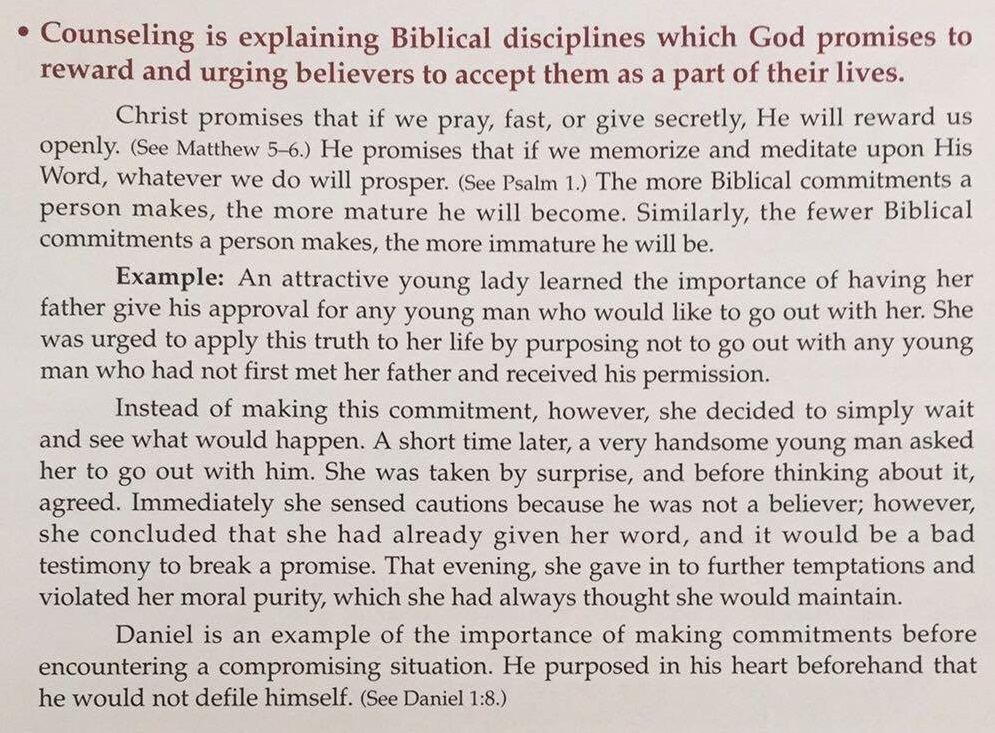
“The more commitments you make, the more mature you will be.”

After reading my last post (click here) a friend sent me actual photographic evidence that people really do think that “building fences” will protect you from sinning.

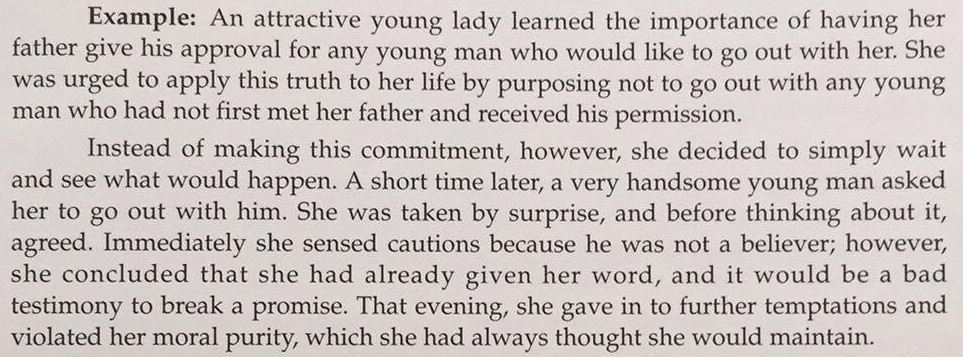
This page is from a “counseling” conference for students (about age 16 to young 20s) held in 2000. The bullet point listed here is just one of probably six or seven; these conferences deluged the attendees with information. It was hard to take it all in, much less judge each point’s validity — even if you had some frame of reference that let you see the problems in the first place.

This was written by the same teacher who wrote this helpful self-motivation checklist right here.*

Counseling1

Let’s take a look at this bit by bit, how about?

CounselingPt1

Oddly, when I went to my (highly effective) counseling sessions, what I most appreciated was how my counselor listened to me. She occasionally asked questions or suggested a different way to understand God or my past. No explaining or urging took place.

Counseling sessions are very individualized, so I imagine that sometimes a counselor might take a different tack that would look more like explaining and urging. But this teaching seems to assume that if people have problems, those people need to be “fixed.” They need to keep behind the fences and follow the rules. That way God will bless them again.

CounselingPt2

Two Bible verses! The first one is pretty solid. The second one is from a Psalm, which is poetry, not exactly cause-and-effect promises. And then, in a giant leap for logickind, he explains and urges that in order to get God’s blessings, you have to make commitments to do good things.

Just in case we might think he made up this theology, he gives us proof: an unverifiable story about anonymous people.

(If you’re thinking, “How could people believe this?”, then you don’t understand the force of a leader’s personality, the high-pressure atmosphere, and the reinforcement from the group where everyone else seems to agree without reservation. You should read my novel, The Fellowship.)

CounselingPt2

I don’t even have to point out what’s wrong with this “example.” But I will anyway.

The story assumes that if the young woman had committed to telling young men to approach her father first, she would be spared Bad Things. We also “know” that she’d be more mature if she made this commitment.

This is one point where he and I agree: this woman was not mature enough to handle a relationship. But turning it over to her dad wouldn’t have helped her in the long run.

After all, she thinks that since she accepted a date in surprise, it’s a binding promise. No, honey. If you’re uncertain about it, email him to say that the day you agreed on wouldn’t work out after all, and you’d really like to think about his offer a little longer. Then, after you’ve thought about it, call him and explain that you have a conflict of faith and you really don’t think it’s a good idea. It will be awkward and he might end up feeling hurt. That’s grown-up life.

But, no, since Daddy isn’t there to rescue her, she goes out with the guy after all and… violates her moral purity? There’s no knowing what that really means in this context. This phrase could refer sex — and if she had sex on the first date despite her conscience, she’s got really serious issues. It could also mean they kissed. Or maybe she wore a low-cut blouse and he complimented her figure. No telling which fence got breached, since breaking any of them counts as sin.

(It’s even possible that it means he forced sexual contact without her consent; since she dated a guy who didn’t have her father’s approval, she’s partly guilty for whatever he did to her. I don’t have the evidence of this logic right here, but it’s definitely part of the thinking.)

The story serves only one purpose: to create fear among his followers so they’ll accept his word as their means of security.

CounselingPt3

Well, yes, Daniel did. But that showed his strength of character. He knew his own mind. He didn’t need to prop up his sagging judgment with “commitments.”

This whole bullet point (and the rest of the material) is flavored with the pungent stench of Bible verses ripped out of context. Teachers like this demonstrate over and over that their concern isn’t what the Bible says or what God is really like. It’s to reinforce their own authority as teachers of truth, as they trap their followers behind miles of fences that God never created.

Amid all that talk of God and Biblical principles and Bible verses, though, this teacher — like most teachers like him — forgot to add a key verse. I’ll do it for him.

“Nothing like what you are saying is happening; you are just making it up out of your head.” Nehemiah 6:8

*The teacher is Bill Gothard of the Institute in Basic Life Principles/Advanced Training Institute. I have no qualms about calling him out by name. But although his material is what I use for my examples, I don’t want to focus solely on him and his teachings. He’s just one of many teachers who peddle legalism, and they all use the same methods.

Are You a Failure? Y/N

The thing about cults and cult-like systems is that, for the most part, they’re really boring.

Most of the indoctrination takes place day by day, through sermons that carefully redefine Scripture, through lectures that reinforce the group’s beliefs, and through long, dull sessions of filling in blanks and regurgitating the right answers.

The question-and-answer exercises are very simplistic, and all designed to condition you to doubt yourself and feel like a failure. You learn to look to your leader for answers, and you’re afraid to leave the group because you know you’ll crash and burn on your own.

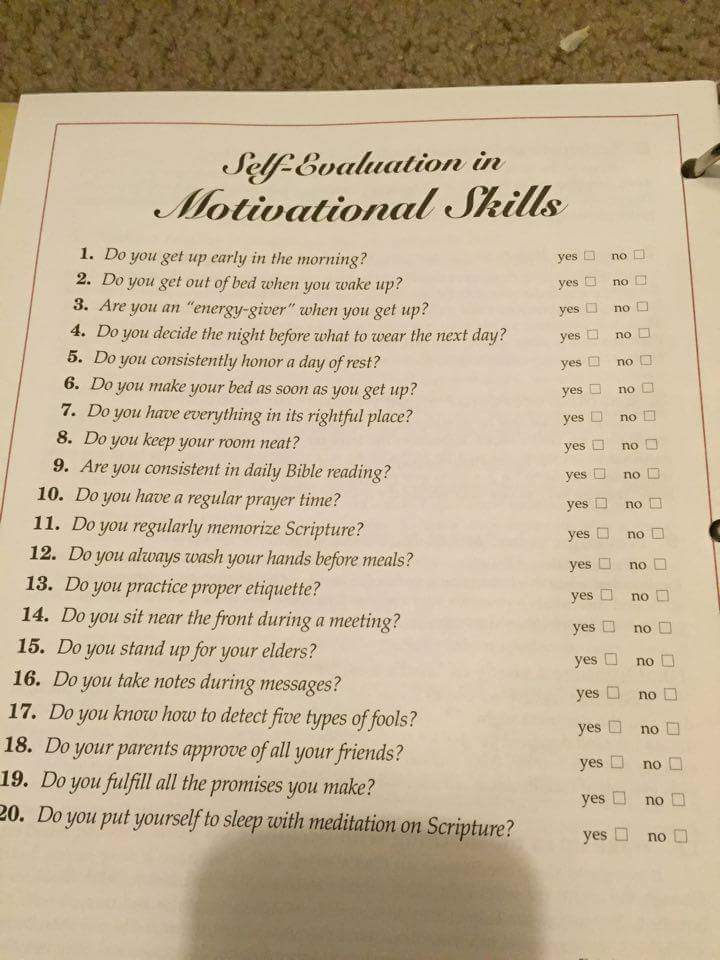
A friend from my own Fellowship* recently shared a snapshot of a worksheet we had to fill out as students in the early 90s. As 14 – 18 year olds, we were separated from our parents at weeks-long conferences, awakened early and kept up late, and bombarded all day with lectures and conditioned group responses. Somewhere in the middle of this exhausting, bewildering, and exhilarating experience, they dropped things like this in our laps:

received_10153698897882180

1. Do you get up early in the morning?

2. Do you get out of bed when you wake up?

3. Are you an “energy-giver” when you get up?

4. Do you decide the night before what to wear the next day?

5. Do you consistently honor a day of rest?

6. Do you make your bed as soon as you get up?

7. Do you have everything in its rightful place?

8. Do you keep your room neat?

9. Are you consistent in your daily Bible reading?

10. Do you have a regular prayer time?

11. Do you regularly memorize Scripture?

12. Do you always wash your hands before meals?

13. Do you practice proper etiquette?

14. Do you sit near the front during a meeting?

15. Do you stand up for your elders?

16. Do you take notes during messages?

17. Do you know how to detect the five types of fools?

18. Do your parents approve of all your friends?

19. Do you fulfill all the promises you make?

20. Do you put yourself to sleep with meditation on Scripture?

*

An outsider could glance over it and say, “Well, there are a lot of great ideas here. Except what does washing your hands have  to do with self-motivation? Just take what’s good and leave the rest.”

An insider knew much better than that.  “No” is not an acceptable answer to any of these questions. Notice that”Sometimes” isn’t even an option. We couldn’t take-and-leave. This wasn’t a mere list of ideas. This was a test, and we were set up to fail it.

Unless you’re educated in the culture that it comes from, you probably still miss how loaded some of these questions are. I could spend a dozen blog posts unpacking these questions.

For instance, “Do you get up early in the morning?” Early rising was a mark of Godliness; sleeping late was, therefore, sinful. The next question, “Do you get out of bed when you wake up?” reinforces the idea that staying in bed is a sign of slothfulness. And there was an entire booklet about the dangers of being slothful. So if you answered “no” to questions 1 & 2, you’re already spiritually defective.

Or how about #14? Sitting in the back of a meeting demonstrated apathy (a sin) or rebelliousness (a major sin).

In order to answer #17, you had to remember the extensivelesson on the Five Types of Fools; so that question actually covered an entirely separate session in itself.

Question #18 weighed about a ton. Your parents had the power of God’s disapproval in your life. If they didn’t like a friend of yours, no matter the reason, the only obedient course of action was to get rid of that friend. Also, “friend” here could stand for “friend of the opposite sex” — someone you liked despite the fact that God expected you to keep your emotions pure until He brought you the one you were to marry. It was a reminder that even your emotions were subject to God/your parents.

The entire list, by the way, is pretty easy to master if you happen to be someone exactly like the Venerated Leader who wrote it — a man who didn’t need much sleep, was an extrovert, found memorization easy, didn’t have any real friends, wore basically the same thing every day, and spent thirty years sexually harassing young women that he invited to work for him. Oh, wait, he forgot to add that item, didn’t he?

Twenty years later, when many of us saw the picture of this list, we felt that same oppression we’d lived under as teenagers. “No wonder,” we said. “No wonder I always felt like a failure. No wonder I worked myself into chronic fatigue. No wonder I broke down at age 20.” This list was just one of many others like it. This was how we knew to please God.

This was our spiritual life, one in which choosing your clothes the night before is just as important as keeping the Sabbath (one of the Ten Commandments). No room for mistakes or personality. Just keep your head down, obey, and pretend you aren’t the complete failure you know you are.

And for the record, I have no idea how washing your hands before every meal made it on this list. That’s stupid.

If you need me, I’ll be lying in bed in my comfortably cluttered room, with no memory of the five types of fools, and resting in the grace of God.

*Bill Gothard, IBLP/ATI

O the Deep, Deep Love of Journals

Recently I found out that my friend Toni at RedPenTravelers.com “made journals.”

I love pretty much all journals. It was a a mark of virtue in my own “Fellowship” to keep a regular diary, and it was something I could actually do, unlike sew my own clothes or get up early to meditate on Scripture.

At some point, our Venerated Teacher came up with the idea that we shouldn’t keep “diaries” that recorded personal stories and weren’t meant to be read; we instead should keep “journals” that were written for the edification of others. So much for my natural advantage; I was being all worldly and sinful after all.

Although I struggled to conform to this godly (ahem, ridiculous) standard, and still managed to fill up several books. And all these years later, I don’t know anybody who would want to slog through the overblown prose of a Southern girl who read too much Jane Austen and developed crushes on her own fictional heroes.

All that to say that when I found out about Toni’s journals, I rushed over to see them. Because, you know, journals. What I found was absolute fabulousness.

A handmade leather journal cover, customized according to my choice of color and state. My hometown marked with a heart, and the front cover stamped with my initials. It all fit in my purse. It fit in my life. I needed that journal cover like my teenage self needed a real boyfriend.

The travel journals are designed to accommodate inserts that you can buy. I folded and trimmed paper to fit mine. You might notice that the paper is blank. These days I don’t fill up journals like I used to. But my love for them is undiminished.

Toni and I weren’t exactly at school together, but we were in the same cult, which makes a way better story. She and I met as teenagers at the big annual conference, when we both wore long skirts and she had long hair (I never could grow my hair to a godly length). We wrote letters for years, then fell out of touch until Facebook dawned, Recovering Grace was launched, and we all worked through the tangles of our past together.

As Miss Red Pen, Toni proofread my novel. As RedPenTravelers, she’s offering a discount for everyone who shows up saying I sent them.

So, be ye sent. Click here to check out her site. Use the coupon code FELLOWSHIP for 10% off your order through this December.

Seriously, why are you even still here? You could be a few minutes closer to holding your own handmade customized leather journal in your hand. And say hi to Toni for me while you’re over there.

*****

The Fellowship is available on Kindle and in print.