Good Excuses (T or F?)

So it appears that it’s been nearly two months since I’ve updated this blog. Since there haven’t been any crises of health or happiness in my life lately, what excuse could I possibly have?

Fortunately, I’ve got lots. I just hope you’re not picky about all of them being, you know, “true.”

Just in case, though, I’ve made a helpful True-False notation after each one.

Reasons For My Absence from The Blog:

  1. Everybody has finally realized the dangers of a rule-based, authoritarian system with no built-in accountability. I have nothing more to write about. (F)
  2. I realized I need to “get under authority” and am shutting down this blog in repentance. All further posts will be submitted (haha) by my husband. (F)
  3. I’m working on a new project, this one a collection of short stories that range in topic from a redneck wife harassed by her ex-husband, to six different versions of a pizza recipe. (T)
  4. I spent three weeks on a cross-country drive through sixteen states with my husband and four kids for no reason other than “we always said we would.” (T)
  5. We spent the first four days of our trip taking turns throwing up into a plastic bucket in the van. (T)
  6. Oh, in connection with #2, I’m dropping my maiden name because of how feminist it looks. Even though I got both names from men. (F, except where I got the names, which is T)
  7. I discovered my new life ambition in Wal-Mart yesterday, when I found an adult coloring book based on novels by Debbie Macomber. One page would feature a quote from one of her dozens of novels, and the facing page was an illustration to color. I’ve never read any Macomber, but I’m inspired. (Haha, obviously F. Totally joking. I mean, unless somebody really wanted to illustrate my quotes. I’ve got some good ones.)
  8. And the Lord might not delight in the legs of a man, according to Psalm Twenty-Seven, but Bekah certainly did. That’s one of my favorite quotes from my novel. (T)
  9. Also, The life-sized cardboard Queen Esther leaned against a nearby tree. Somebody had taped a paper cup to her hand. I’d enjoy coloring that. (T)
  10. I’ve been living a busy life as a woman free of anxiety about authority, God’s wrath, or how clean my home is. I’m also working hard to have a new book to offer by the end of the year. So that’s why the blog took a little pause. Thanks for dropping in to say hello again. (T)

Marriage Mind Games

ball-1418250-1279x850A godly wife is submissive. A godly husband is a leader. This is the ideal model of marriage, as laid down by a God who likes making his children play mind games.

It’s not news that I’m no fan of the patriarchal/complementarian view of marriage. I sat through hours of the instruction as a teen. I even tried it when I first got married, with pretty terrible results. It causes more harm than good most of the time. But don’t take my word for it—here’s an article from one of the bastions of submissive womanhood, Above Rubies, with a rundown of how the game goes.

I found the article when someone shared it on my newsfeed, after Above Rubies posted it on their Facebook page. Considering that the working title of my novel was Somewhere Below Rubies, I’m obviously not the target audience. But it’s exactly the kind of stuff I was taught, and obviously still going strong.

You can read the whole thing here. Here on the blog, I’ll provide excerpts. With commentary, naturally.*

The author leaps into motion with the starting gun:

… God spoke to me and said, “Val, you cannot teach this message… Because you don’t understand submission!” Now I don’t mind admitting that I was shocked.

“Lord, do you realize that I’m Val Stares from Above Rubies? I’ve always encouraged submission.” “Yes,” was the reply, “but you still don’t know how to submit.” By now I was on the defensive. “But. Lord, you know that every time I want something, or desire to go somewhere, I always ask my husband first.”

“And what is his reply?”

“He says for me to please myself. Oh yes, he always adds, ‘You usually do.’ I don’t know why he says that because he’s already given me permission to do what I think best.”

Her husband’s reply is an interesting detail. Does he mean it casually, as a lighthearted way to say, “Yes!” or as an unstated resentful way to remind her that she doesn’t really care about his opinion? I’d think that God, who surely has as much basic education as a first-year marriage counselor, would suggest that she ask her husband what he’s really thinking.

But no. The patriarchal God rarely goes in for direct, heart-to-heart talks. That spoils the game.

“If you are serious about learning submission, Val, I want you to go to your husband and tell him that from now on he needs to answer you, “Yes” or “No.” If he says that you can please yourself, then you will take that as his disapproval and will stay home or go without. There is to be no pouting, no banging doors, no attitude of annoyance or hurt when this happens.”

So “God” has laid down the ground rules. Val runs out to the shed where her husband spends a lot of his time, and tells him her new revelation. He laughed—“You’ll never be able to do it!”

About three weeks later, a visiting speaker came to town.
Note the passage of time. Three weeks later.

Finally it was time to ask my husband if I could go. Out to the shed I went, told him what was happening and asked if I could go. As usual, I left everything until the last minute!
That little drop of self-blame is essential to the truly submissive woman’s worldview.

“Please yourself, you usually do.”
That’s how he answered. He didn’t say the magic words. Remember what he was supposed to say? “Yes” or “No.” Anything else meant he didn’t actually approve and she had to stay home. Because God said so.

I raced into the bedroom and pleaded with God, “He’s forgotten he has to say ‘Yes’ or ‘No.’ Can’t I just remind him?” “No” came the answer to my heart…
Because if you did that, it would totally ruin God’s fun.

Around the time I should have left for the meeting, my husband walked in to find me cleaning. “I thought you were going out to a meeting,” he said.
This is a major play right here. She explained how he had really forbidden her from going because he didn’t use the right words. And her husband got mad. He yelled at her that if she wanted to be so stupid and stay home, then fine, stay home!

It was then that the full revelation of what God was teaching me became clear.
I don’t know about you, but I’m revelating all over the place here.

I’m getting the impression that Val is an energetic, take-charge kind of person. Women who run ministries usually are. And she married a low-key, easygoing man. This is a perfectly normal and acceptable personality pairing—except in patriarchal/complementarian circles. In those circles, a take-charge woman has to force herself to be indecisive and subservient, but in order to do so, she’s got to compel her easygoing husband to order her around. However, according to God’s fun little game, she can’t say that.

So Val decided for some reason that her husband’s dismissive “Please yourself, you usually do” wasn’t up to par. She made up a code that he had to follow to show he was really leading her. Meanwhile, her husband thought he’d given her permission to do something she wanted to do, only to discover that she’d denied herself and blamed him. No wonder he was mad.

Oh, hang on. That’s not at all what Val concludes. Instead, she chalks up a major score in the mind game.

I had overridden my husband’s decision so many times that he was now robbed of any desire to lead. He must have felt so cheated. Now, by God’s hand, he was responsible for me staying home, but what hurt me most was the realization that it was me, the Christian wife, who had robbed him!
It’s a homerun, folks!

 My husband is a cautious man and rather slow at making decisions. My impatience at waiting for an answer caused me to make more and more decisions myself and he would go along with me for the sake of peace.
Or maybe he figured out a long time ago that you manipulate the situation to get what you really want, so his actual opinion didn’t really matter.

 I stayed home for several weeks after that, while we both learned our respective roles.
While he learned your official change in the rules, you mean.

So that’s the story part. Now she’s got to get into the doctrine part to justify why they dodge and block instead of talking things out like responsible adults. She quotes some usual verses on submission (Ephesians 5:22, Colossians 3:18) and adds all the usual explanations:

God is not telling husbands to make us obey or make us come under their authority. We do it because we love God and our husbands, and because He has asked us to. It is our choice.
Even though in her own story, she had no choice once “God” told her to do it.

In my mind I saw my broom raised to a horizontal position above my head. The handle was labeled, “My husband’s Authority.” I could see that if he were in his rightful position, I would be able to walk beneath it in an upright position. This upright position was one of honor, security, love–and a surprise I didn’t expect or notice until much later–power!

This is one of their favorite plays. They insist that a woman who doesn’t make any decisions on her own, but lets her husband dictate everything, is in fact very powerful. They point to Esther, who had enormous influence over the king. That’s the kind of influence a truly submissive wife has! All she has to do is go into every situation thinking, as Esther did, “I’ll ask him about this. If I die, I die.” What’s so hard about that?

Just because the things I wanted to do were good things, didn’t necessarily mean they were what my husband wanted to do. He could have other plans.
Not that she asked if he had other plans. Not that he told her he had other plans. They are very careful not to mess up God’s favorite sport.

But God wanted me to measure myself by the attitude of Jesus.

We read about Jesus’ example in 1 Peter 2:18-23, “For what glory is it, if when ye be buffeted for your faults, ye shall take it patiently? But if, when ye do well, and suffer for it, ye take it patiently, this is acceptable with God. For even hereunto were ye called: because Christ also suffered for us, leaving us an example, that ye should follow his steps…Who, when he was reviled, reviled not again; when he suffered, he threatened not; but committed himself to him that judges righteously….Likewise, (with the same spirit of Jesus) ye wives, be in subjection to your own husbands; that, if any obey not the Word, they also may without the word be won by the conversation (the manner of life) of the wives.”

This is actually what 1 Peter 2:18-23 says. It’s written to servants (slaves, as translated in the New International Version).

“18 Servants, be subject to your masters with all fear; not only to the good and gentle, but also to the froward.

19 For this is thankworthy, if a man for conscience toward God endure grief, suffering wrongfully.

20 For what glory is it, if, when ye be buffeted for your faults, ye shall take it patiently? but if, when ye do well, and suffer for it, ye take it patiently, this is acceptable with God.

21 For even hereunto were ye called: because Christ also suffered for us, leaving us an example, that ye should follow his steps:

22 Who did no sin, neither was guile found in his mouth:

23 Who, when he was reviled, reviled not again; when he suffered, he threatened not; but committed himself to him that judgeth righteously:”

It looks a whole lot like she tacked on 1 Peter 3:1, the verse about wives, without saying so. Not only is she quoting Scripture out of context, she just created her very own Frankensteinian context! Slam dunk!

What happened to that feared and dreaded “door mat,” the so-called intimidated mousy wife who gets no say? It was a lie. It had no substance or power. I can now stand up straight, and walk upright, secure and loved under his protection. On this side of submission, I have more say because my opinion is of greater value than before.
In a spectacular leap of logic, she concludes that by not expressing her opinion on anything, it has greater value. Touchdown, baby! GOOOAAALLL!

One word of warning– submission is a daily practice, not a one-time act. I have to daily check my attitude and the humility of my heart.
But it’s even harder to work every day at communicating with each other, balancing each other’s desires with your own needs, taking care of misunderstandings as they happen. No guarantees, no formula to fall back on—just love, effort, and God’s grace.

But in the long run, your marriage grows stronger when you don’t depend on formulas, but take the risk to meet as equals and face issues together.

We serve a God of grace.

Not a God of mind games.

Game, set, match.


*Should I apologize for the unholy mixing of sports references? That would suggest that I’m sorry for it.

Phantom Enemies

ghost-1-1312149-1280x960One day on the battlefield, I looked up and realized I was fighting phantoms.

Before I go any further, I’m going to say this:

  1. I’m not going to apologize for being cautious around a person or situation that feels not-normal. I’m a woman and a mother, and God didn’t give me deeply-imbedded survival instincts just for kicks. I’m also a rational human being, so I can evaluate whether those instincts ring true or not; but meanwhile, if I feel uneasy, I will take precautions to keep myself and my children safe.
  2. Predators and terrorists are real dangers. That’s why they’re so frightening. The possibility of a zombie attack at the grocery store doesn’t make your throat close up with fear.

That said…

Two remarks recently revealed how hard I was fighting illusions.

The first was while I was having coffee with some other women. We were talking about what our kids enjoyed doing, and I lamented that I couldn’t let my children walk anywhere. “We live right off a highway and people drive fast. It’s just not safe.”

The others nodded, and one added, “And you never know what the Muslims will do.”

We were in a hipster coffee shop in a predominately white Christian town. In my middle-class suburban bubble, I hadn’t seen a non-white person all morning.

The second remark was in some discussion about transgender bathroom policies. Someone declared, “I work hard enough to keep my kids safe as it is, without this added risk!”

I’ve probably used a public bathroom with a transgendered person without knowing it. Still, I do think that we’d do well to acknowledge the risks of allowing predatory men easier access to women’s bathrooms. But I heard that comment and thought, “How many times have you had to defend your children against attackers this week?”

She would say, “Every minute of my day!” What she means is, “I’m on alert every minute of my day.” But as for actual attacks? In a typical week in my circle of friends, that would be zero.

What these two comments clarified for me was that I spend a lot of energy defending myself and my family against enemies who might be, but aren’t actually, attacking me. When I took a step back to see who my actual attackers are, I was stunned.

I’ve had a very good life, but not a perfect one. Throughout the years, people have hurt me. And that group of people—the one that I by all rights should be wary of now—has been

White

Middle-class

Heterosexual

American

Christians

It makes sense. That’s who I am, and that’s who I associate with. If I were to guard against the actual “enemies” who have hurt me, I’d be cautious around smiling men in dark suits who teach toxic theology. I’d protect my children from manipulative women who just “want the best” for my family. Stories of terrorists and predators would concern me, but an ordinary guy who assumes I’m not as good as he is because I don’t think like he does—that should terrify me.

They don’t, though, because they’re known enemies. It’s the unknown that scares me.

It’s good to be aware of trends, movements, and dangers. As I said to begin with, I don’t apologize for being careful in situations that make me uneasy. But the thing about phantom enemies is that you never, ever beat them. They always come back. So I end up enslaved to fear, which makes me want to follow anyone who promises safety… which is often someone who preys on fear for his or her own selfish ends. And in my life, that’s almost invariably been a white middle-class heterosexual American Christianish kind of person.

Phantom enemies deliver us into the hands of real ones. And that’s really what should scare us most.

Deborah: When Men are Weak

king-and-queen-1179013-639x462Apparently in some of the back streets of the internet, there’s a fight about whether movies should star “strong female characters.” The whole question makes me nearly sprain something rolling my eyes, so I don’t actually know much about it.


I did read a post on the subject, though. The author, a woman, wrote it in response to a man who objected to “strong females” in stories. He claimed that they usurped a man’s rightful, God-given place as the protector of the weak.

Among other points in her post, the author of the rebuttal mentioned the Biblical example of Deborah. And I thought, “You think you won a point. But you really lost it.”

The thing about Christian patriarchalists is that they know their Bible. They know it like Westley and Inigo knew their fencing forms. It’s kind of like a game, sparring with them. First they lay down the rules—you must argue from the Bible. Nothing else is authoritative. Then they show up with all their Bible knowledge and interpretation and demolish you. They know what you’ll say, and they’ve developed a reflexive response for it. Maybe, if you’re really good at holding your own, they might acknowledge—as Westley did to Inigo—that you’re an artist of stained glass window caliber.

But how is bringing up Deborah in a debate about female leadership an automatic loss?

Yes, we’re talking about the same Deborah, the Old Testament judge, whose story is found in Judges 4-5. She lived during the time before Israel had kings. The people listened to her for God’s words and judgements, especially during this time when a nearby king oppressed them.

Deborah sent for Barak, obviously a warrior of renown. She informed him that God wanted him to gather troops and go against the enemy general, Sisera, in battle. Barak kind of blanched at the thought and said, “I’ll go if you go with me.”

“Fine, I’ll go,” Deborah said. “But just so you know—you’re not going to get any glory from this. Sisera will die by a woman.”

So they went up together and Barak mustered his troops. They met Sisera in battle; it didn’t go well for Sisera. God routed his army, and he himself escaped on foot. He found the tent of an ally, whose wife—Jael—invited him in to rest.

(Jael is the stuff of nightmares to patriarchal men. She pretended to be friendly, waited till Sisera collapsed from exhaustion, and then drove a tent peg through his head.)

Israel won a definitive victory, and the entire next chapter is “the Song of Deborah and Barak.”

If you read the account straight through, you might not see where Deborah went wrong. That’s because you’re probably forgetting the most important principle for interpreting a Bible story about a woman: authority.

Who was in authority? It’s hard to get around the fact that it’s Deborah. She was even married but still looked to as the judge. But women aren’t ever supposed to be in authority over men, therefore Deborah’s judgeship was somehow not God’s best. Even though God doesn’t seem to have realized that.

The teachers I sat under pointed to the fact that Barak was so reluctant. If this warrior was too uncertain to go into battle without Deborah, what did that say about the men of the time? Exactly. They were all weak. That’s why there was a woman in charge—because there weren’t any good men to step up and do it.

So the story isn’t about Deborah’s strength, but Barak’s weakness. It’s not Deborah’s honor, but Barak’s shame. It’s not about a woman, it’s about a man.

And there’s obviously an element of that, since it’s such a point that the victory went to “a woman.” But without the Authority filter over it, the story in general kind of shrugs at the fact that Deborah’s in charge. The point is not woman or man, but God.

But if you find yourself locked in combat with a patriachalist over female empowerment, and the twisty logic, leaps to conclusions, and sheer vigor of his arguments have forced you to the wall—don’t bring up Deborah. He’s already got her properly boxed up and out of the way. All you will do is reinforce his point (to himself) that a strong woman is merely compensating for a weak man. A woman who is trying to be “strong” is therefore trying to “weaken” a man.

It’s right there in the Bible. Remember Deborah?


Hymns Revisited

Part of me loves the hymns I grew up with. Part of me tries to escape them, scrambling backwards and knocking stuff over.

I’ve got reasons for my reaction, which possibly isn’t as measured and reasonable as it could be.

For one thing, some of the words of these “hymns” are incredibly insipid. For instance, the bouncy little song  “At the Cross,” which took a weighty Isaac Watts poem:

Alas, and did my Savior bleed,
And did my Sovereign die?
Would He devote that sacred head
For such a worm as I?

And stuck a catchy gospel chorus to it:
At the cross!
At the cross!
Where I first saw the light,
And the burden of my heart was rolled away!
It was there by faith I received my sight
And now I am happy all the day!

Yeah, so, you know — the ultimate sacrifice of a sinless God to save wretched sinners… it sure does make me happy all the day!

For another thing, I can’t stand some of the tunes. A Mighty Fortress Is Our God has fantastic words. But good heavens, who wrote that tune and thought, “Yeah! This is IT! Congregational singing, HERE WE COME!”? You start off at a full run and don’t even get to pause for breath between the first and second phrases:

“AmightyfortressisourGodabulkwarneverfailing!”

It’s like an entire hymn in hashtag form.

Other tunes are so locked in their nineteenth- and twentieth-century sound that they’re almost painful to twenty-first century ears. Sweet Hour of Prayer, Blessed Be the Tie, What a Friend We Have in Jesus, Softly and Tenderly. They drag. They whine. I cannot stand those tunes.

But so what? Big deal. Everybody who ever attended church likes some songs and not others. Why does that qualify me to run in the other direction?

Well, because for years I was taught by a now-discredited teacher that these hymns were the only acceptable music to listen to. He did allow some classical music (except for Stravinksy, and Debussy was suspect too, and if he’d ever heard of Gershwin then that would have been off-limits as well). Some Celtic and bluegrass slipped under the line, too. (I practically overdosed on Ungar&Mason’s album, The Lover’s Waltz.) But mostly my available music consisted of hymns arranged in an approved style.

So my life was filled with these hymns. The beautiful (Praise to the Lord the Almighty; Holy, Holy, Holy); the fluffy (Victory in Jesus; Lily of the Valley); and the insipid or annoying (see above).

I couldn’t pick and choose to like them because my options were so limited.Besides, there’s no room in a Godly life to say that you don’t like Godly music.

Once I realized that I could step beyond those artificial boundaries, I walked away from hymns. I liked listening to DJ play and sing at the piano, but I was angry that they had been forced on me as “the only good” music when some of it was patently not good.

Yet part of me still loves many of those songs.

A few months ago, I discovered Chris Rice’s song “Untitled Hymn (Come to Jesus)”. It’s written in the style of an old mountain hymn, very simple words* and tune; but all the verses together trace a thread through the life of a Christian, from “sing to Jesus” to “fall on Jesus” to “dance for Jesus,” and finally death — “fly to Jesus.” It’s surprisingly touching, especially since Rice doesn’t try to make it fancy. He just sings.

When I found a 2007 album by Rice called “The Hymns Project,” I thought maybe he could salvage some of those old songs I really want to love. He didn’t disappoint me.

He liberates a couple of hymns from their swingy-slidey rhythm (“Rock of Ages” and “The Old Rugged Cross”). He takes one song that drags like a toddler going to bed, and gives it energy (“O Love That Will Not Let Me Go”). And he included one hymn that I love almost no matter how it’s arranged, “Come Thou Fount of Every Blessing”:

O to grace how great a debtor
Daily I’m constrained to be
Let thy goodness like a fetter
Bind my wandering heart to thee

Prone to wander, Lord I feel it
Prone to leave the God I love;
Here’s my heart, oh, take and seal it
Seal it for thy courts above.

I used to dislike this verse — that whole thing about the “fetter.” But now I deeply appreciate the idea that I can’t wander away from God. He lets me walk away, but never so far that I can’t find him again.

The best thing about this album is that Rice just sings. He doesn’t try to make the hymns more than they are. That’s when I realized there’s actually a lot to them.

I didn’t like every song (even Rice couldn’t mellow out A Mighty Fortress). That made me happy, too, since it reminded me that I’m free to pick and choose.

So if you’re like me and wary of hymns, give this one a try.

Source: Amazon.com: Peace Like A River: The Hymns Project: Chris Rice: MP3 Downloads

*The lyrics “Like a newborn baby/Don’t be afraid to crawl” is a slight jar, I admit. Newborn babies don’t crawl, and the only thing they’re afraid of is starving to death immediately right now even while a nipple is being inserted into their screaming mouths. But it’s minor. Just go with it.


A Little Collection

In a completely self-indulgent blog moment, I’m posting pictures that remind me of my novel.

Writers are always — yea, even obsessively — looking for and collecting characters, settings, and elements from their stories. That means we find pictures of houses, random items, and, ahem, actual people who don’t actually know that they are being collected.

Case in point, I’m a little sad that I missed the chance to get a picture of a young woman in a red jeep the other day. It was a perfect Bekah picture. Unfortunately, the light changed and I had to drive away. Stupid traffic laws.

Anyway, here are a few little things from my Fellowship collection. You do have to have read the novel to appreciate them. (Haven’t read it yet? Click the link to get your copy.)

This unsuspecting couple at a coffee shop became Bekah Richards and Ty Williams. They’re not dead ringers for those characters, but they capture the right spirit. I’m going to pretend that’s iced tea in those glasses, though. Bekah’s is unsweet, of course.

20150531_1248451

Another time, at a festival in another town, I came across Rob Branner. (The actual man had a British accent that was just devastating. But I bet Rob’s Southern drawl isn’t too shabby either.)

12493590_456174304591477_2089065657598653185_o

Graveyards are a hobby of mine. No, really; my husband and I even walked through one during our honeymoon. I wander through the headstones, noting distinctive names, and wondering about the people’s whose lives have already come and gone.

It was at this cemetery, four or five years ago, that I found the perfect name for my church founder.

20160407_185957

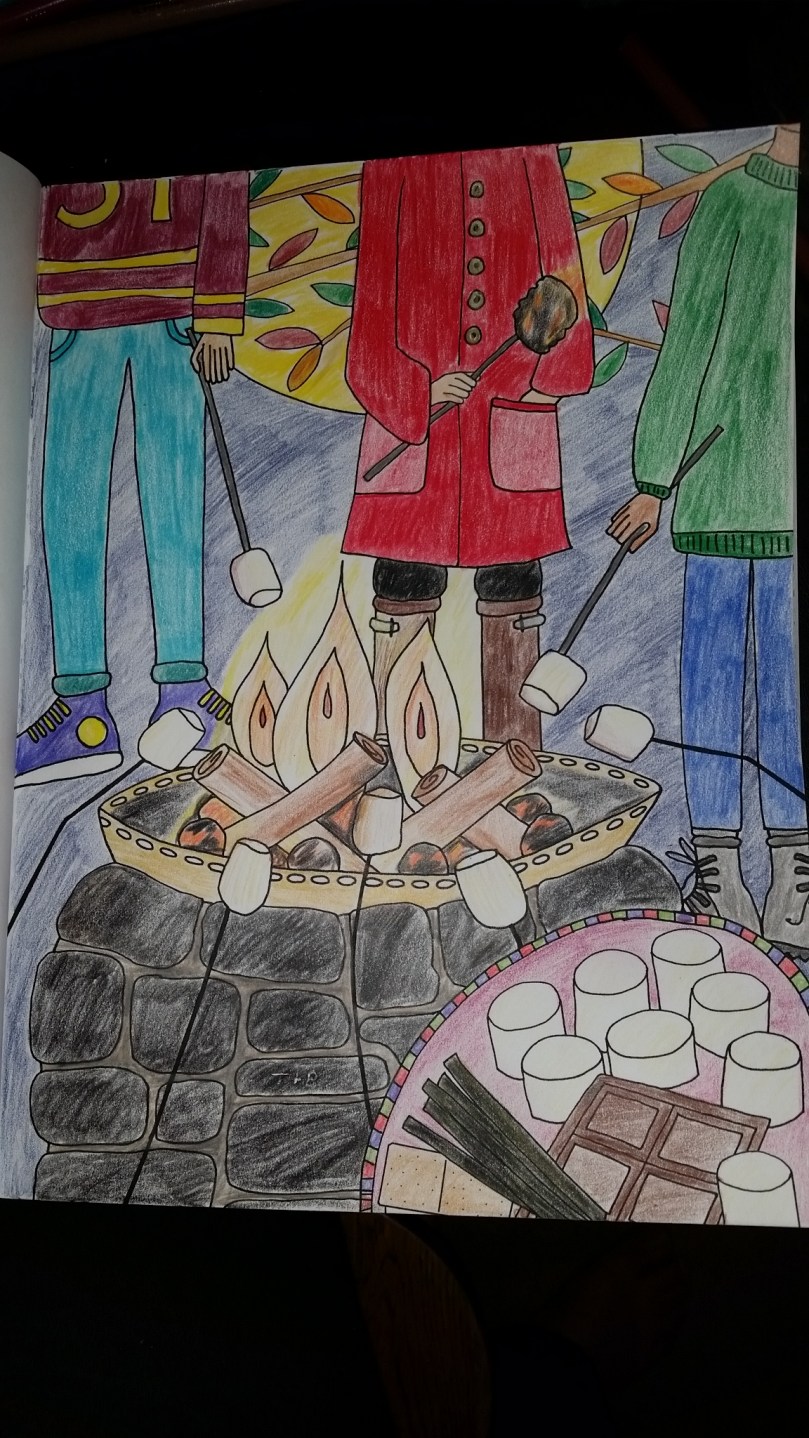
I (reluctantly joined the trend and) color. I particularly enjoy pictures that let me think about the people who live in my head. There’s a marshmallow-roasting scene in The Fellowship, in which Bekah says she likes her marshmallows “burned.” Rob replies that the proper term is “Flambe.” When she eats the black, crispy, gooey marshmallow, Rob remarks, “That’s revolting.”

That line is actually a kind of an inside joke between DJ and me. On one of our early dates, I took him to Dairy Queen, where we both got Blizzards. I spent more time talking than eating, until my Blizzard melted. DJ — who, by the way, still didn’t have my official answer that we were actually a couple so needed to play his cards just right — looked at the brownish sludge in my cup and said, “That’s revolting.”

And I fell hard for that confidence.

In honor of that scene, I gave Bekah (in the red coat) a burned marshmallow. But this isn’t the scene from the book, which takes place in the summer. This is later, after the novel has ended but the characters live on to have marshmallow roasts over a fire pit.

20160409_174914

When I was working on the picture, however, I pointed out the tray in the lower right corner. I thought it was cheese and crackers, but I couldn’t figure out what the cylinders were supposed to be. Sushi?

DJ said, “I think they’re marshmallows, since you’ve got the graham crackers and chocolate…”

And I started laughing. I’d colored the roasting sticks green because I thought they were celery:

20160409_173015

Graham crackers, chocolate, marshmallows, and celery… now that’s revolting.

The Good Patriarchy

paper-family-ii-1176053-1599x987

Patriarchists aren’t all bad.

Statements like that sound charitable, but they’re usually not. For one thing, as soon as I start thinking of people as a generic group– “Fundamentalists” “Liberals” “Right-Wingers” “The Gays” “Rednecks” — I stop seeing them as real people. They (plural) become a faceless figure (singular) imbued with everything I dislike about their particular set of ideas.

So to say that Patriarchists aren’t all bad, I’m basically conceding that they might have some actual human qualities.

My point here is much more generous, I hope.

People embrace a Christian patriarchal worldview for real reasons. The world has problems, and everyone is looking for solutions. As I once heard it said, “I like the questions they ask. I just don’t like all their answers.”

Here are some good reasons why people are “Patriarchists”:

Men need respect. (Yes, and also love.)  This is especially true for that almost invisible population of men who aren’t particularly handsome or flashy, nor are they violent and oppressive. They’re devoted to those they love. They work hard, worry a lot, do the best they can to provide and protect. You will find these men all through the ranks of the patriarchy camp. They’re sincere and faithful. They deserve respect. In a patriarchal system, they get it.

Women should plan their futures with motherhood in mind. Obviously I’ve got strong opinions about women’s education and future. But if a woman has any desire at all to have children, she needs to factor that into her plans. She has no idea beforehand how pregnancy will affect her. She could be on bedrest for six months, throwing up for nine, or simply too sleepy to function after 5pm. And it’s simple fact that mothers usually take on most of the work during the baby and toddler years.It’s smart to learn time management, childcare, and cooking. It’s also smart to look for a man who will be able to provide for the family if motherhood knocks her off her feet for a while. Patriarchy has this foresight built into its system.

Structure provides security. Life is scary and unpredictable. If you’ve already got a framework for handling decisions and expectations, it gives you something to fall back on. My dad died when I was three, leaving my mother with five children. But in that small Southern society thirty years ago, it was understood that the men of the family would do all they could to take care of the women. My grandfather and uncle stepped in and filled up a huge, gaping hole in our lives until my mom got back on her feet. In patriarchy, the men are accustomed to stepping up.

Men and Women (in general) are different and need one another for balance. I know, I know, not all women are highly emotional, and some men stop and ask for directions. Male/female stereotypes cease to be helpful very quickly. Still, there are obvious biological differences, and as a group, women and men approach life differently. A world with both masculine and feminine influence is a rich one. Patriarchy recognizes these differences in a positive light.

God pervades everything. In Christian patriarchy, there is no real distinction between secular and sacred. Everything you do is in service to God. You eventually go through everyday life in a constant awareness and communion with God.

I sincerely believe these things are good. So why don’t we want to return to the world of patriarchy?

Because it is not a self-correcting system.

As long as you get good people who are willing to compromise, be flexible, and understand other points of view — patriarchy can function very well for the people involved.

But if things go bad, the people under authority have no way to check or challenge the people in control. And it’s not really an “if”– when humans are involved, things will go wrong.

So Patriarchists aren’t all bad. I fight against the error of villainizing those who don’t see things my way. But I can look at a system that allows bad people to stay in control, and I can say: That is not good.


A Review: “Gave Me a Deeper Understanding”

Gretchen Louise at Kindred Grace has posted a review of The Fellowship. 

Different people notice different aspects of the story. Some have remarked on how easy it was to get to know the characters. Some recognize specific teachings or experiences. Some love the often-irreverent humor, and a lot of people held out hope that it wasn’t really lost. (What wasn’t? Hm, looks like you should read the story.)

What Gretchen highlights is the fact that “the familiar” is a very strong force. It’s often easier to stay in a bad but familiar situation than risk a new, possibly better, one.

But I think what stood out to me most in The Fellowship is how comfortable the familiar could become. As much as Bekah loved the taste of freedom, the rules that had bound her for so long were so very compelling… At the same time, I was given a much deeper understanding into the mindset of those who are unwilling to leave unhealthy and even dangerous situations.

Read the entire review here, and linger to browse her beautiful site.

Bleeding Praise

They opened a Bible and
Drew out a gleaming
Metal sheath, polished silver
Studded with rubies.
They said it was good.

They said the beautiful sheath
Enclosed treasure to
Carry deep inside my heart –
God’s gift for God’s child.
I stretched out my hand.

They unclasped a silver lock.
The sheath broke apart
Revealing a slender smooth
Steel blade, thin and sharp.
I accepted it.

I took the chilled metal blade
Which did not warm to
My touch, and they showed me just
How I must hold it.
Poised over my heart.

Together, we drove it in.
Easily, it pierced
My chest. The handle snapped off,
The blade disappeared
Deep within my heart.

They looked at the bright red blood
Welling from my heart,
Smearing and staining my skin.
Blood is life, they said—
God’s abundant life.

They reproached me for my tears,
Said I must be strong,
Said my heart was rebellious
Said it was Your gift.
I must love the pain.

I loved the pain, rejoicing
In abundant life.
My bleeding and wounded heart
Sang praises to You
In grief and despair.

I cherished the deep-set blade
Having forgotten
That it was not part of me.
Not remembering
That they put it there.

You came near to me and saw
That I was dying,
Slowly, while gasping praises
As each new heartbeat
Tore wider the wound.

You whispered in my anguish,
Said the sharp steel blade
Was not a treasure of Yours.
Pain stopped up my ears
I couldn’t hear You.

You slid Your fingers into
My agonized heart.
Then I knew You were with me.
Fear and pain burned me.
I begged You to leave.

Peace, be still, is all You said.
You drew out the blade.
It was pitted, slimy, dark.
My torn heart closed up.
I cried soft, warm tears.

Quietly You embraced me,
Stanched the bright red blood
With Your own bloodstained fingers
Said You don’t love pain.
But You love to heal.

You washed my skin and my clothes
And bound up my heart.
You shattered the ugly blade,
Asked for no praises.
Told me to just breathe.

Abigail, A Dangerous Woman

The Bible doesn’t pull any punches when it comes to exposing dangerous women. The first one who comes to your mind, just like mine, is Abigail.

Lest you think we’re talking about two different Old Testament characters, I’ll give a rundown of her story. It’s found in 1 Samuel 25.

In the years before David became king of Israel, he was on the run from Saul–the current king–and building up his own following. They happened upon the fields of Nabal during shearing time. David sent ten men to Nabal saying, “Hey, we didn’t mess with your shepherds or steal any of your sheep or goats. So could you give me food for my men?”

It was a big request. But Nabal was a rich man. More to the point, he was still rich thanks to David’s honorable treatment of his property. Also, David’s men had weapons. Like any reasonable man, Nabal saw that it was to his advantage to pay up his part of the bargain.

Oh, wait. Nabal’s name means “fool.” He did not pay up. He insulted David and told him to get lost.

David got mad and began mobilizing his men for wholesale slaughter of every male in Nabal’s household.

(See, class? We sure do need for men to be in charge all the time because it always goes so much better that way.)

Abigail was Nabal’s wife. When a servant came to her in a panic, telling her what was going on, she swung into action. She gathered up food, freshened up, saddled a donkey, and went out to meet David herself. She apologized for her husband’s foolishness and begged him to spare the household.

David, hotheaded though he was, was actually a reasonable man, especially by ancient warlord standards. He agreed to call off the attack. In fact, he was relieved that Abigail had kept him from unnecessary bloodshed.

Abigail went back and told Nabal what she’d done. Nabal was furious. So absolutely, intensely furious that he had a stroke and then died.

So the household was saved, Nabal disposed of, and David took Abigail to be his wife. Which really was the best a woman could hope for in that time.

Okay, so I admit that at first glance, it actually looks like Abigail is the hero of this story. But one of the tricks of a patriarchal worldview is that it can use one or two details to twist the whole perspective into the proper shape.

To start with, you’ve got to keep the most important principle in mind at all time. That principle is: Authority. Every situation, even a story told for centuries around campfires, must be filtered through the grid of Authority.

Who was in authority in this story? Well, David, because he’d been anointed the next king of Israel. Who else had authority here? Nabal, the husband and owner of the property.

Who did not have the authority to make any decisions or take any action? Abigail. Because she was married, she was bound to obey her husband no matter what.

There are two telling details in the passage of Scripture. One, the servant came to Abigail behind Nabal’s back, and even said he was wicked and foolish. Abigail did not rebuke the servant for speaking against their authority. Two, Abigail made her plans and headed out to see David, but as the story notes, She did not tell her husband.

But… but… she spared every  male in the household! Including Nabal’s worthless hindquarters!

Yet you see what her rebellion–yes, she was rebellious–led to. Her husband died. David might feel like God had vindicated him, but Abigail had to live with the knowledge that her actions killed her own husband.

But… but… Abigail became David’s wife…

Pfft. She became one of his wives. Who wants that? (What woman had a choice back then? Hush, you’re cluttering up the narrative.) And she did have at least one son who should have become king after David, but we never hear anything about him. That’s the third devastating detail in this story: God punished Abigail by not letting her son become the next king.

I’m not exaggerating this interpretation. This is what I was taught as a student of Bill Gothard. He embroidered a lot of the details*, but there’s a long tradition among hardcore patriarchalists to demonize Abigail. She usurped her husband’s place and was the cause of his death.

Girls, do not grow up to be like Abigail!

You should instead hope to be like… well… how about you just don’t read ahead in your Bibles until we have time to explain how Ruth, Esther, Deborah, Jael, etc. are also cautionary tales. Here, instead we’ve rewritten history and also these stories with passive obedient heroines. We’ll get back to God’s Word when you’re ready to understand the truths hidden within it.

Good thing you’ve got men to illuminate it for you.

*Gothard claimed that if Abigail hadn’t intervened, then David would have had the guilt of unnecessary bloodshed on his conscience; years later, when he got Bathsheba pregnant, he wouldn’t have sent Uriah into battle to be killed because he’d already know how wrong that was. I didn’t make that up.

** I hope it’s clear that I’m not claiming all Christian men believe this way. But there’s a slice of Christianity that does. If you’ve never encountered teachings like this, you might not realize the enormous effort it takes to re-read the Bible in its own words, not the twisted interpretation we were given.