The Courtship Package

hold-my-hand-1492424-1279x1801

In Chapter 5 of The Fellowship, Bekah’s good friend Ty gives her a ride home to her parents’ for the weekend. He’s begun to suspect that the “weird church” Bekah grew up in affects her thinking more than he realized. Bekah fields his questions about authority, college, a woman’s role in life, and they eventually get around to “courtship.”

“Courting…?” Ty said.

Bekah groaned.

He went on, “That basically means getting engaged, right?”

“No. We’ve had this conversation before too.” 

“I know. I just can’t keep straight… oh, hang on. It means you can’t hold hands till you get married.”

“Exactly. Glad you listened when I explained it.”

“No, no, wait, I remember more now. It means you can’t hold hands until you marry the guy your dad says you can marry.”

“You’re definitely not going to be speaking at any Youth Meetings.”

“How would you explain courtship then?”

“It means not starting a romantic relationship until you’re ready for marriage. And you have to have the blessing of both fathers. And the guy initiates the relationship, not the girl.” Bekah didn’t add the dozens of other rules and expectations that were included in the courtship package.

*

My husband and I courted. We waited until we were ready for marriage before we started a romance (we were already friends). He contacted my mother first (both my dad and stepdad were dead, a situation that the patriarchy movement tends to gloss over). We involved our parents and families in our activities. We set boundaries in our relationship, including saving our first kiss for the wedding. (Full disclosure: we didn’t save everything for the wedding; we felt very free to make out within our boundaries.) For years I was a big fan of courtship… until I figured out why ours went so well. We did it wrong.

DJ and I made all the decisions ourselves. Our parents were available for consultation — I talked for hours with my mom before agreeing to court him — but they didn’t have any final say. It never occurred to them to try to make our decisions for us. We took charge of our relationship, and it’s served us well all these years later.

But we have many friends whose parents very much considered themselves the active authority in the relationship. Those courtships rarely went well. Either the couple was too compliant and didn’t learn how to function as a united force, or one or both parties aggressively asserted independence and everybody suffered from the emotional fallout. As one friend said later, “My courtship was the most miserable time of my life.”

All too often, “courtship” ends up looking a lot like these rather poetic essays from two friends:

Davad:

When I was 14, the homeschool fathers said, “Read your Bible, abstain from sex, and in a few years you’ll be ready for one of our daughters.” And I did.

When I was 18, the fathers said, “Work hard, be creative, and make something of your life, and in a few years you’ll be ready for marriage.” And I did.

When I was 22, the fathers said, “Embrace our theology for yourself, get a career that pays as much as we make now, and you’ll be ready to court.” And I did.

When I was 26, they said, “Why are you so independent from your parents, go to a different church in a different state, and don’t respect their authority? The answer is no.”

Rachel:
When I was 14 I was told, “Promise God you will never date, try with all your energy to turn your crushes into something else, learn how to be content with only your parents and your brother as friends, and one day you’ll catch the attention of a godly man.”

I did.

At 18 I was told, “Focus on ministry, minimize your own dreams and desires, give selflessly at home, learn to submit to your parents at home, and soon a godly man will notice you.”

I did.

At 22 I was told, “The godly man you think is the one isn’t the one, trust us. So submit to your parents’ better judgement and discipline your heart to be quiet while they make it impossible for this man to know you well enough to consider you. Focus on serving. Focus on giving. And soon the right godly man will notice you.”

I did.

At 29 I was told, “The godly man who has seen you, noticed you, and admired you while you’ve been giving and serving and ministering, isn’t committed to courtship, and you promised us when you were 14 that you wouldn’t date. So this is not the right godly man. Just…”

I stopped listening.

I’m married to him.

But the years I wasted are never far from my consciousness.

*

The problem isn’t that parents are involved, or express disapproval, or set high standards. The problem is, as expressed a little later in the novel:

“I don’t resist the idea of authority,” Ty objected. “What I resist is somebody telling me that he speaks for God in my life, and if I don’t listen to him I’m screwed.” 

Looking back, here’s what I see:

  • Some people did everything right and have a beautiful marriage now.
  • Some people did everything right and are picking up the pieces of shattered dreams.
  • Some did everything as stupidly as possible, and suffered from years of misery.
  • Others did the same thing and ended up wiser, a bit storm-tossed, and happily married.

The Courtship Package was sold to us as a way to prevent bad things from happening. But the promise was empty. Formulas don’t guarantee success. Even God doesn’t guarantee that everything will go well. Trusting in a formula leaves us shattered and helpless when things go wrong. Trusting in God gives someone to grab onto when everything is falling apart.

So I’m not really a fan of “courtship” anymore. I’m a fan of two people knowing their own minds and getting to know one another, and standing together before God and the world.

*

Click here to order (print) or pre-order (Kindle) The Fellowship.
First Things First

You emerge from the closed-in world of Christian patriarchy with a broken worldview and a long list of issues you need to figure out. Where on earth do you start?

Well, speaking as one who has spent the past fifteen years walking the recovery journey with many others, I’ve got a suggestion. Before you revisit anything else…

…Courtship vs Dating

…Friendships

…Modesty

…The Bible

…Godly Womanhood/Manhood

…Sex

or even Authority…

Before all that, immerse yourself in Grace.

If you’re like I was, you have no concept of what “grace” really means. As I was taught it, grace was merely another way to obey more, work harder, do more.

Good news: I was wrong.

You can find some good definitions of grace. The most common one is God’s unmerited favor toward humans. That always sounded too much like churchspeak to resonate with me.

Near the end of my novel, I explain grace as God’s approval that we don’t deserve. We don’t have to be good enough.

I like that okay, although I gave a definition mostly for the story’s sake.

My favorite explanation of grace came from my exploration into the Eastern Orthodox Church several years ago. Eastern Orthodoxy tends to be much more mystical than we Westerners are used to. It also doesn’t get hung up on precise definitions.

So what is grace? It’s God giving us part of Himself. Not “power” or “favor” or whatever. He gives us Him. We don’t have to do enough or be enough. He’s already there, filling up where we fall short, keeping us afloat when we’re too tired to try any more.

So while you’re struggling and crying and begging for answers… Start with grace. Let God — the real God, not the angry god of legalism — sink into your soul. After a while, you can move on from there. Go slow. God’s got all the time in the world.

The Ministry of Shania Twain

shania_twain_up

Up until I was 14, I listened to secular pop music. But I spent my teen years under a Venerated Teacher who assured me that ungodly music would give Satan ground in my soul. He even used a diagram that showed my soul as a grid. Every time I listened to a “rock song,” I surrendered a square of that grid to Satan. (Apparently Satan advanced his kingdom by square inches, who knew?)

We all learned to draw this diagram, including little black fortresses on the “ground” we’d surrendered. The only way to reclaim it was to pray, specifically, that God would take back that ground. Oh, and to stop listening to rock music.

So for almost ten years, I carefully avoided anything with a certain beat, a certain sound, or from certain eras. I wasn’t sure how much square footage my soul contained, after all.

I got married at 23, and that was about the time I started realizing that my Venerated Teacher taught more nonsense than wisdom. Within a couple of years, I dared to venture back into the world of ungodly music.

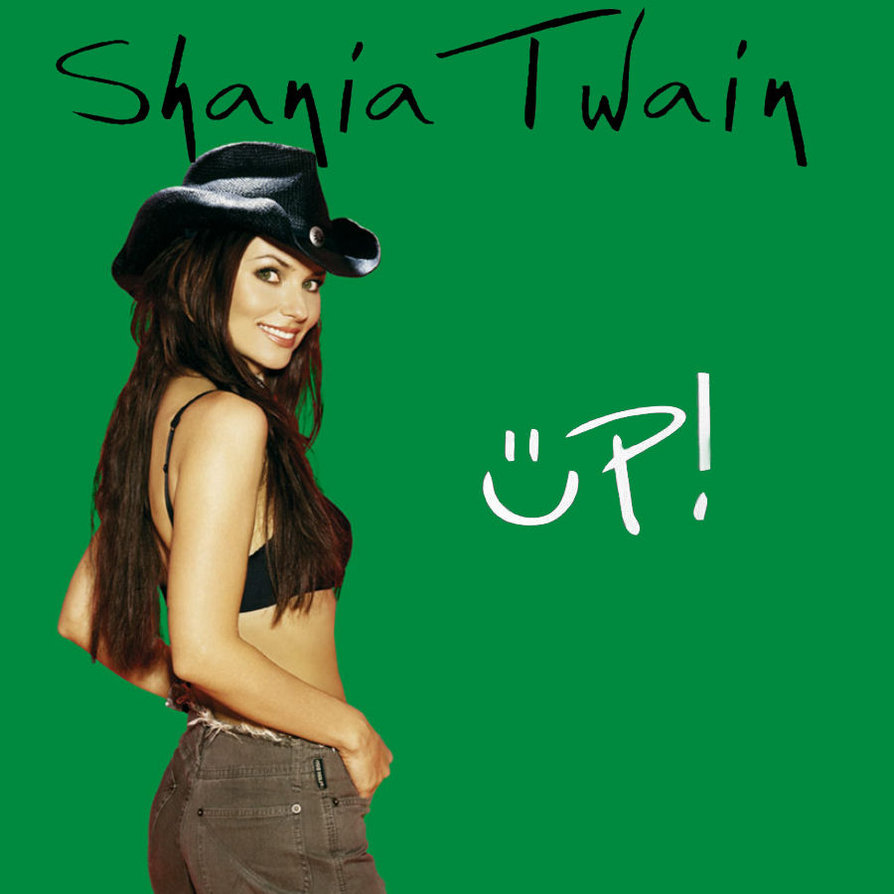
Throwing concern for my soul to the wind, I bought three CDs: Sara Evans’ Born to Fly, Jo Dee Messina’s Greatest Hits, and Shania Twain’s Up.

The interesting thing about these choices is that they all have a major kick of girl power. And of all of them, Shania kicked the hardest.

Recently, I pulled out that music again. It took me back to those early years when I still lived on the fringes of a culture of womanly submission and sexual repression.

I remember now that it gave me a zing to listen to a song that said, “You’re a fine piece of real estate, and I’m gonna get me some land.” And coming from a world where a broken courtship was deeply embarrassing and morally questionable, it was therapeutic to hear a woman say, “It was never gonna work/You were too much of a jerk… I miss you now and then but would I do it all again? Nah.”

I needed that sass and confidence. I needed permission to disagree with accepted opinions… or just say, “Nah.”

All these years later, I’ll still listen to the Messina album. Evans’ “Born to Fly” is still one of my favorite songs. (Obviously I was channeling Bekah Richards years before I put her into words.) As for Up, I wouldn’t say that the music has aged extremely well. In fact, most of the songs are downright cheesy. But they’re also fun, flippant, and assertive. For better or for worse, they played a big part in my recovery.

I still had a long walk ahead of me as I remembered who I was, not who I was supposed to be. But I have to confess… Shania gave me a running start.

*****

Order your copy of The Fellowship!

The Inner Dialogue of an Indie Author

Me: There are errors in the novel.

InnerMe: Errors? Like what? You accidentally killed off somebody in Chapter 16? “Everything came to a screeching halt when, the next morning, Bekah woke up dead…”

Me: Aren’t you funny. No, the story’s solid. I mean formatting errors. And some typos.

InnerMe: You knew that would happen.

Me: But that doesn’t mean I wanted it to.

InnerMe: And you’re going to get them corrected.

Me: But there will still be copies floating around with errors!

InnerMe: But your whole story is about how you don’t have to be perfect!

Me: Well, yeah, but I’m not selling these copies to God. People are notoriously lax when it comes to extending grace toward novels.

InnerMe: Ahem. Like… you?

Me: What?

InnerMe: Let’s discuss the books you’ve verbally shredded over the years because they didn’t meet your exalted standards…

Me: Let’s don’t.

InnerMe: Twiiiiliiiight….

Me: Shut up! I said my story is solid! Twilight has some serious plot problems, like…

InnerMe: Forget I mentioned it. Please. All I’m saying is that you might be dreading a taste of your own medicine.

Me: That’s a cliche.

InnerMe: If the shoe fits…

Me: I can’t believe my inner voice speaks in cliches!

InnerMe: Seriously, are you just going to sit around stewing about some errors that you’re going to fix but can’t right at this moment?

Me: Well… I could stew about the fact that the house is a wreck too.

InnerMe: The house is always messy.

Me: I know, and I’m fine with that in general. But it’s reached a unacceptable level of messy.

InnerMe: We can fix that! Right now!

Me: Yes! You are totally right! CONQUER THE MESS!

InnerMe: And… sorry about the cliches.

Me: It’s okay. It’s the thought that counts. Oh my gosh, did I just…

InnerMe: Grab a scrubby. We really need to get to work.

Revealing (the) Outfit

My title made me laugh.

The pictures I posted in my previous post are — as many of you knew or guessed — a “modest” swimsuit. I suppose it would also work for an acrobat, Krisa. Tara, I would be delighted to get one for you for a hot anniversary celebration, if you want.

It’s very lightweight, and there are leg-loops and a bottom snap to keep the skirt from flying up. In more subdued colors, it might not even be such an assault on the eye. True, that is a knee-length skirt going on there, which just isn’t safe; but the swimsuit is pretty well-designed for its purpose.

It’s the purpose that I object to. I’m just fine with the fact that women have certain features that particularly appeal to men’s sexual appetites, and it’s a mark of respect to herself to cover them up for the general public. What I don’t like is the idea that a woman must obliterate the shape of her own body, or else she tempts men to lust and therefore sins.

But that’s everyday life for Bekah and her friends in the Fellowship. Their swimwear covers their bodies from neck to knees… but they still swim in a separate area from where the boys swim. You can’t be too careful.

Inspiring lust isn’t something that Bekah herself worries about much; she doesn’t see herself as especially beautiful. But her friend Meghan has all the right curves no matter how modestly she dresses. And as the story unfolds… that proves to be a real problem.

All of you who commented are entered into a drawing for the novel once it’s launched — congratulations!

Her Clothing is Spandex and Old Glory

The post title is taken from Proverbs 31:22. It’s the Modern American Version.

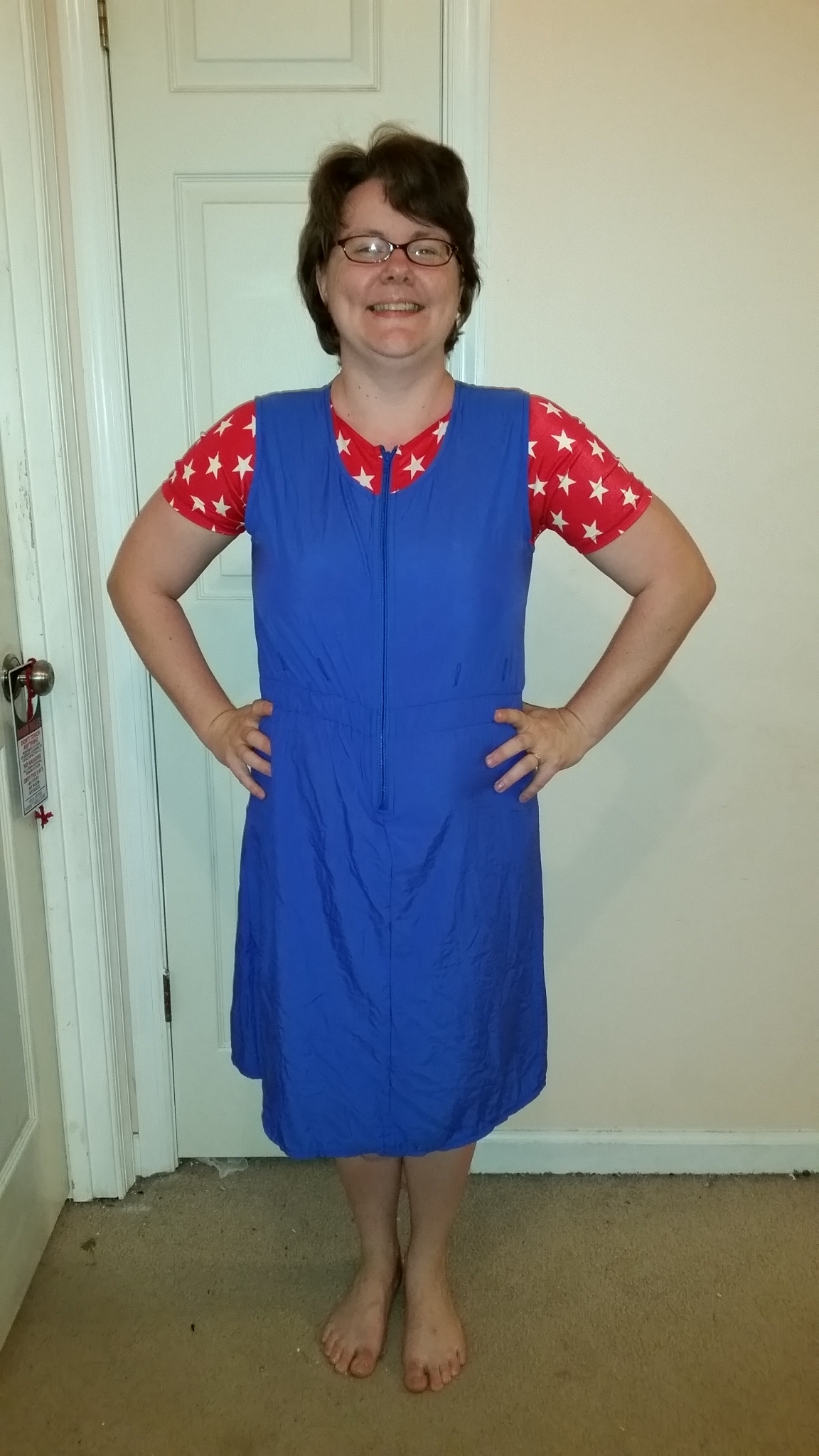
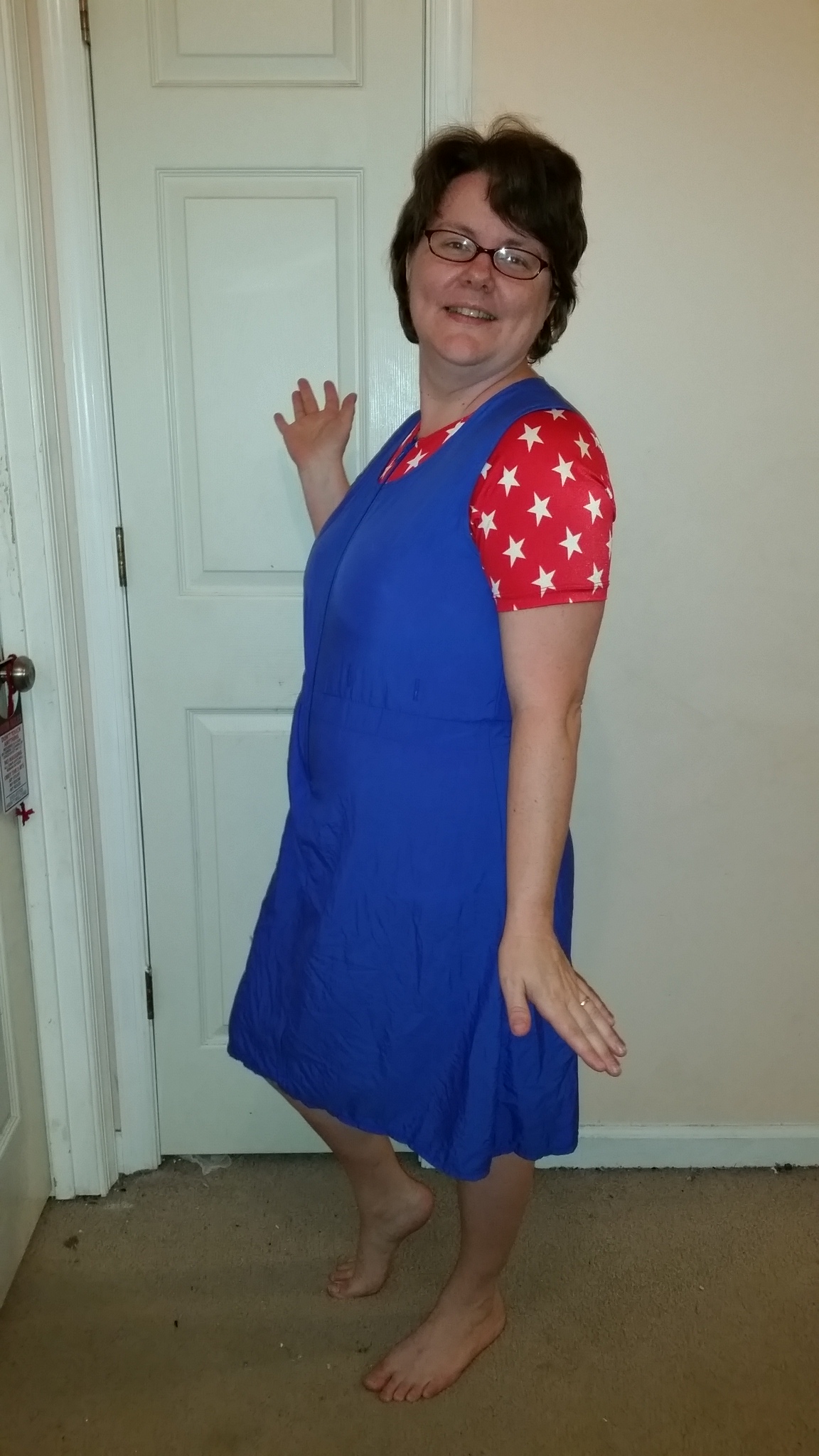
I was recently given this outfit by a friend who snickered a lot as I opened the box. I squeezed into the star-spangled suit — I think I need a size up — and we beheld my modest self with wonder.

20151010_190306

It would be much admired in the Fellowship, especially if a woman is a high enough level of virtuous womanhood to make it herself. Note how it smooths out most of those pesky female curves that are such a trial to men.

20151010_190302

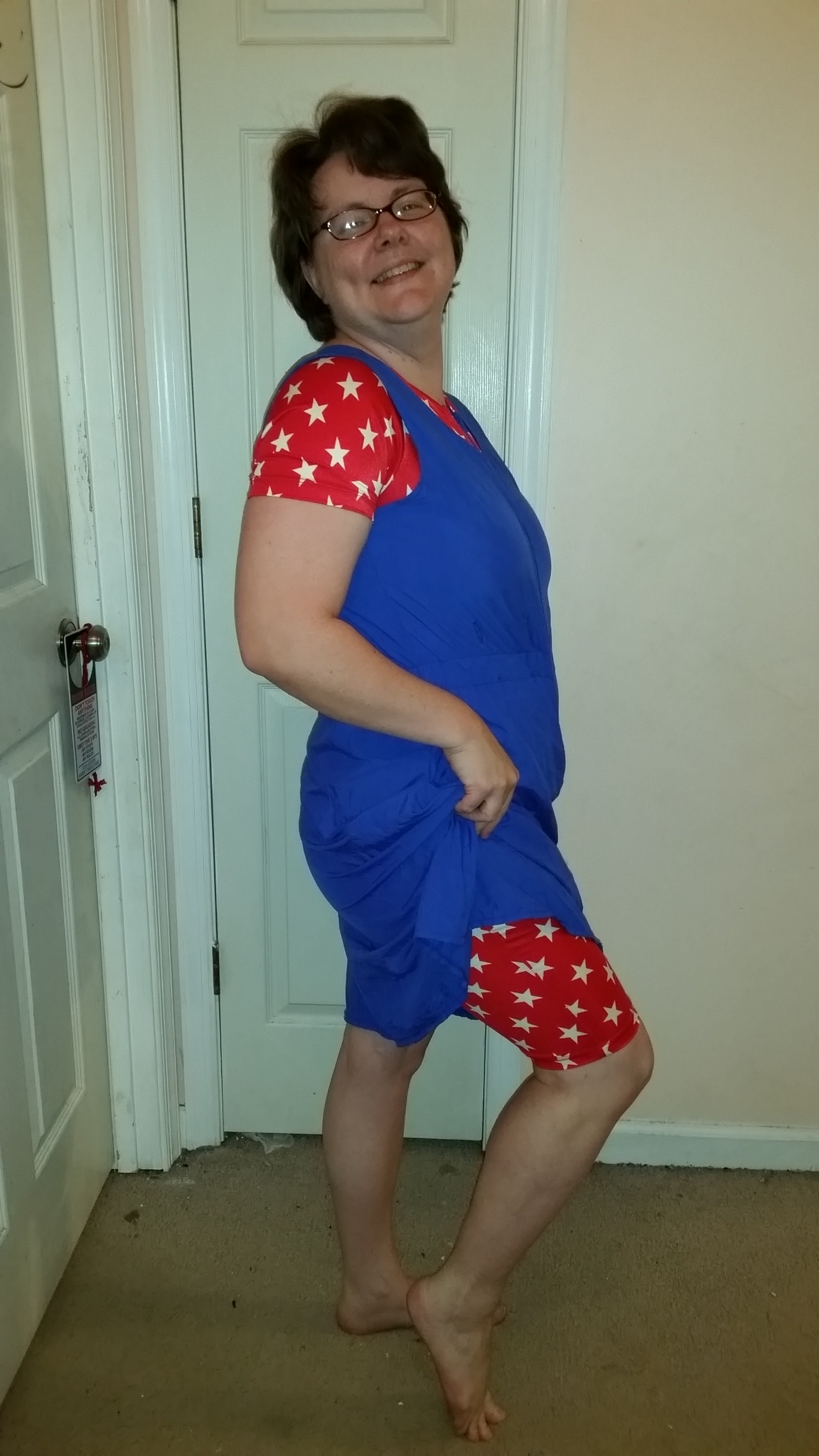
But a woman can never be too guarded against immodesty. It lurks under every hem.

20151010_190250

Do you know what the outfit is?

Comment below (whether you know or not) and be entered into a drawing for a free copy of The Fellowship, which actually mentions one of these in passing.

Warding Off Superstition

A couple of friends have pointed out that my launch date (ahem, November 13, ahem) is, in fact, a Friday the 13th.

And that’s kind of like poetic justice because nobody in the Fellowship is superstitious. God controls everything, so there’s no such thing as “unlucky days.”

Instead, Fellowshippers (and a lot of Christians outside of fiction) adhere to straight Biblical truth about cause-and-effect:

10989451_977357745657960_5766566684478885014_n

But saying bad luck is because we don’t complete certain rituals to ward off evil? Utter malarky.

Answers, in Novel Form

Why would you read this book?

Well, besides the fact that it’s a good story, it’s got realistic characters, and some pretty funny lines (if I may say so myself)?

Right, besides that. The novel isn’t just entertainment, nor is it revenge for the hurts of my past. I wrote it to answer some of the questions that all of us from this background encounter all too often.

It was already in the final stages of editing when Josh Duggar from “19 Kids and Counting” turned up as having serious sexual issues underneath the respectable clothes and boyish face. Those of us who knew how he grew up weren’t really surprised, but a lot of others were. And we started hearing those questions from a much wider audience.

They run along these lines:

  • Why do people get involved in cults?
  • Why do people stay once they realize something is wrong?
  • What’s wrong with a woman wanting to be “just” a wife and mother? Look at [fill in blank of wife of patriarchal figure]. She’s obviously happy!
  • Why won’t a woman in a system like that leave her cheating or abusive husband?
  • Why can’t they move on from the spiritual abuse? Can’t they “eat the meat and spit out the bones”? Why do they always try to throw the baby out with the bathwater?

The Fellowship attempts to answer these questions. The story shows the effect that an authoritarian culture has on its members — and how the system is designed to protect itself at the expense of anything (or anyone) else.

Of course, one novel can’t fully answer all these questions. My own experience is far too limited to do them justice. I chose to illuminate what it’s like to be part of an almost-normal cult. No dark rituals or demonic encounters. Just your basic selfish, abusive humans. Just an angry, distant deity ready to punish you if you step out of line.

So if you’ve ever asked any of those questions, or ever tried to answer them… well, there you go. That’s why you’d read this book.

And there are some good lines in it, too.

******

The Fellowship will be released on November 13. Click on the title to preorder your copy!